Guide
How Long Does a Landlord Have to Fix Repairs?
A plain-English guide to repair timescales for social-housing tenants in England: what the law says, how urgency affects the timetable, and what to do when your landlord misses its own deadline.
Landlord Record is independent and is not affiliated with, or endorsed by, the Housing Ombudsman Service. We organise and analyse decisions published under the Open Government Licence.
The short answer is: it depends on urgency. Under section 11 of the Landlord and Tenant Act 1985, your landlord must keep the structure and exterior of your home in repair and ensure that installations for heating, hot water, electricity, gas and sanitation are working. The law says this must be done in a reasonable time, rather than setting a single fixed deadline for every repair. Our analysis of 18,064 published Housing Ombudsman decisions shows repair delays feature in 12,399 determinations — making it one of the most common complaint themes residents raise.
In practice, most social landlords group repairs into three categories — emergency, urgent and routine — and publish their own target timescales. These targets are not statutory deadlines in themselves, but if a landlord repeatedly misses them without a good reason, the Housing Ombudsman may find maladministration. The Ombudsman has also criticised landlords for poor record-keeping, failing to communicate with residents, and leaving people without essential services for extended periods.
Understanding your landlord's published repairs policy is the first step to holding them to account. Most policies are available on the landlord's website or can be requested in writing. Check whether your repair is classified as emergency, urgent or routine, and note the target response time. If the landlord's own policy is unclear, that itself can be a ground for complaint, because residents cannot meet expectations they do not know.
The legal duty: section 11 LTA 1985 and the Fitness for Human Habitation Act
Section 11 of the Landlord and Tenant Act 1985 imposes a covenant on most social landlords to keep in repair the structure and exterior of the dwelling, including drains, gutters and external pipes, and to keep in working order the installations for the supply of water, gas, electricity, sanitation and space heating. This duty is not limited to fixing problems after they are reported — the landlord must also keep the property in a state that prevents disrepair from arising.
The Homes (Fitness for Human Habitation) Act 2018 added further obligations. It requires that rented accommodation is fit for human habitation at the start of the tenancy and remains so throughout. The Act lists specific matters to be considered, including repair, damp, ventilation, water supply, drainage, sanitary conveniences and facilities for preparation and cooking of food. If your home is not fit, you may have a claim under the Act as well as under section 11.
Neither statute gives a fixed number of days for every repair. Instead, both use the standard of reasonableness. What is reasonable depends on the nature of the defect, the risk it poses, the season, and how quickly the landlord can reasonably obtain materials and contractors. A gas leak is plainly more urgent than a loose door handle, and a total loss of heating in January is more serious than the same fault in July.
Typical timescales by repair type
Although the law does not prescribe exact days, most councils and housing associations publish repairs policies that set target response times. The table below shows the categories and typical targets used across England:
| Category | Common examples | Typical landlord target |
|---|---|---|
| Emergency | Gas leak, unsafe electrics, total loss of heating in winter, major uncontained water leak, structural damage, broken toilet (only one in home) | Within 24 hours |
| Urgent | Partial heating loss, leaking roof, broken window, blocked sink, loose handrail, minor plumbing leak that can be contained | Up to 7 days |
| Routine | Minor plastering, door adjustments, fencing, external decoration, replacement of non-essential fittings | Up to 28 days (sometimes longer) |
These are targets, not legal guarantees. If your landlord's policy says 24 hours for an emergency and it takes 48 hours, that may still be reasonable if the delay was caused by a severe weather event or a shortage of qualified engineers. The Ombudsman looks at the overall handling, not just the clock. What matters is whether the landlord acted reasonably, kept you informed, and had a plan to put things right.
What to do if your landlord misses the timescale
If a repair is not started or completed within your landlord's stated target, chase it in writing. Quote your original report, include any reference number, and remind the landlord of its own policy. Set a clear deadline for a response — for example, "Please confirm when the repair will be carried out within the next 48 hours."
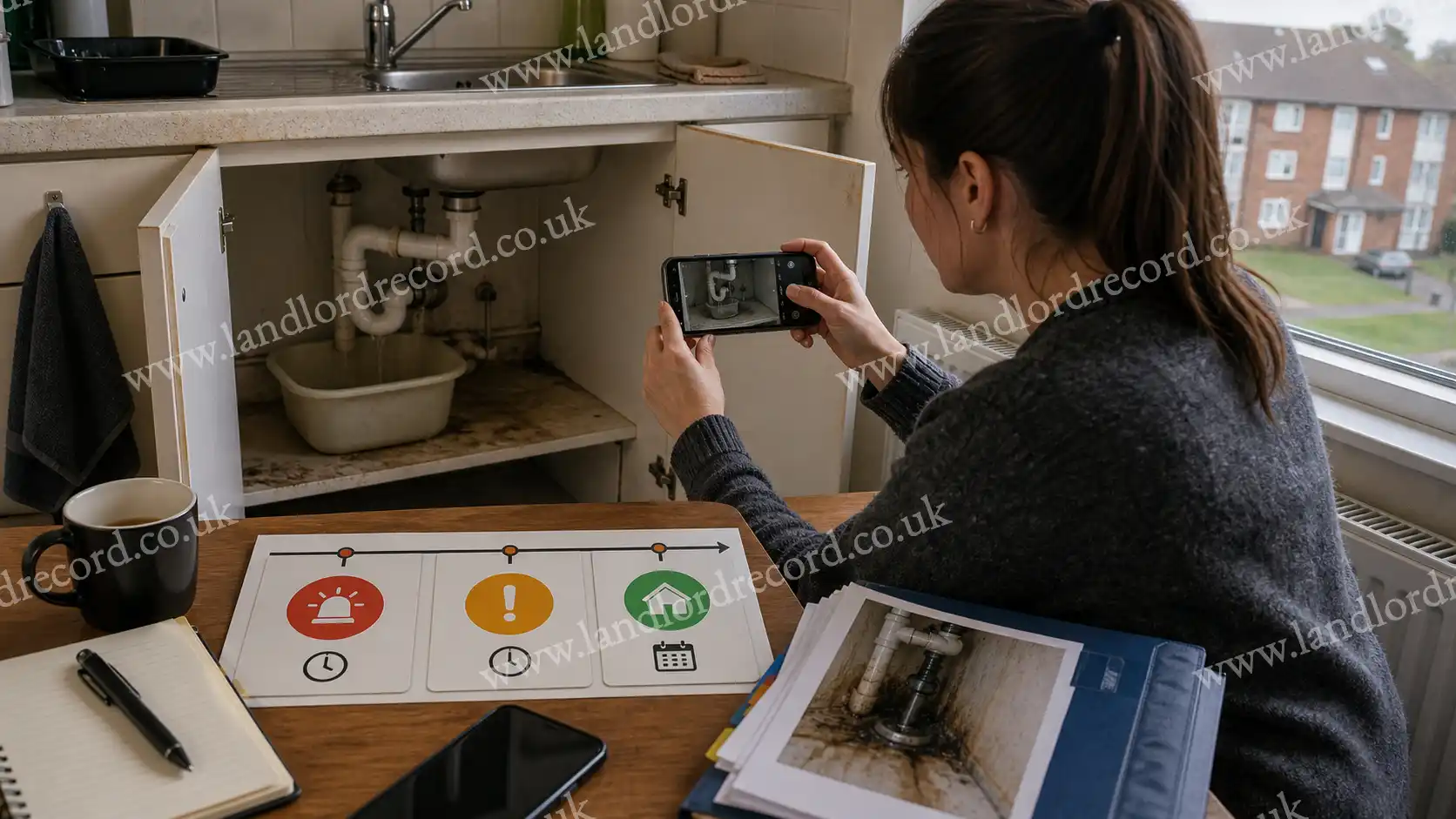
Keep a detailed record: dates, names, what was said, and what was promised. Take dated photographs showing that the problem persists. If a contractor fails to attend, note that down too. This evidence is essential if you later need to escalate.
If chasing does not work, escalate through your landlord's formal complaints process. Under the Housing Ombudsman's Complaint Handling Code, the landlord must acknowledge a Stage 1 complaint promptly and respond within ten working days. If you are not satisfied, you can ask for a Stage 2 review, which should receive a final response within twenty working days. Once Stage 2 is complete — or if the landlord fails to respond within a reasonable time — you can bring your complaint to the Housing Ombudsman. See our guide on what to do if your landlord won't fix repairs for a step-by-step walkthrough.
If the disrepair is a serious hazard to health or safety, you can also contact your local council's environmental health team. Environmental health has enforcement powers under the Housing Health and Safety Rating System and can require the landlord to carry out works. This runs separately from the complaints process and can be used alongside it.
You can also raise the issue with your local councillor or Member of Parliament. While they cannot intervene directly in individual repair cases, they can ask questions of the landlord and, in the case of council housing, press for policy changes. Many residents find that raising the matter with an elected representative accelerates a response, particularly when the landlord is a local authority.
What the Housing Ombudsman has found about repair delays
The Housing Ombudsman regularly finds maladministration where landlords fail to handle repairs within a reasonable time. Common failings include: not responding to the initial report promptly, failing to keep the resident informed, repeatedly cancelling or missing appointments, poor record-keeping, and leaving the resident without an essential service for a prolonged period. The Ombudsman does not enforce a fixed timetable — it examines whether the landlord's handling was reasonable in the circumstances.
Where the Ombudsman does find fault, it can order a range of remedies: an apology, the completion of the repair, compensation, a review of the repairs policy, staff training, and specific action to prevent the problem recurring. Compensation is not automatic; it depends on the severity and duration of the failing and the impact on the resident. For more on how the Ombudsman approaches compensation, see our housing disrepair compensation guide.
The Ombudsman also monitors compliance with its orders. If a landlord fails to implement an order within the specified timeframe, the Ombudsman can escalate the matter and publish the landlord's name. This public accountability is one reason why Ombudsman findings carry significant weight. You can explore how different landlords perform by browsing our responsive repairs decisions or the highest-compensation rankings.
The Right to Repair scheme
If you are a council tenant in England, you may have additional rights under the Right to Repair scheme. This applies to a set list of qualifying repairs — such as unsafe power sockets, leaking roofs and broken heating systems — each with a statutory cost limit and a fixed timescale. If the council does not complete a qualifying repair within that timescale, you can claim fixed compensation that increases the longer the delay continues. Alternatively, you may be able to arrange the repair yourself and claim the cost back, subject to the scheme's limits. The scheme does not apply to housing association tenants. Our Right to Repair explained guide covers the full list and claiming process.
Can you get compensation for repair delays?
Yes, in appropriate cases. The Ombudsman can order compensation where it finds that the landlord handled your repair unreasonably. The award reflects distress, inconvenience, time and trouble — not the cost of the repair itself. In serious or prolonged cases, particularly where health or safety is affected, awards can be higher. You can browse the highest-compensation league table to see the range of past awards.
Council tenants may also have a separate statutory entitlement under the Right to Repair scheme for qualifying repairs that miss their deadline. This does not require a finding of maladministration and is fixed by law. It can be claimed in addition to, or instead of, an Ombudsman complaint, depending on your situation.
If you are unsure which route applies, start by checking whether your repair appears on the statutory qualifying list and whether your landlord is a council or a housing association. Housing association tenants do not have Right to Repair rights but can still complain to the Ombudsman and, in some cases, pursue a claim under the Fitness for Human Habitation Act.
Our index currently holds 18,064 published determinations across 625 landlords. Every statistic is drawn from published Housing Ombudsman decisions — Landlord Record analysis of Housing Ombudsman decisions (OGL v3.0). Search the decisions or browse the responsive repairs category.
Frequently asked questions
Frequently asked questions
How long can a landlord delay repairs?
There is no universal statutory deadline for every repair. Under section 11 of the Landlord and Tenant Act 1985, landlords must carry out repairs within a "reasonable" time, which depends on the urgency of the problem. Emergency repairs — such as a gas leak, unsafe electrics or a total loss of heating in winter — should be started within 24 hours. Urgent repairs are usually expected within 7 days, and routine repairs within 28 days. If your landlord consistently misses these timescales without good reason, that can amount to maladministration.
How long does a landlord have to fix a leak in the UK?
It depends on the severity. A major uncontained water leak that poses a risk to health or safety is an emergency and should be addressed within 24 hours. A minor leak that can be contained and does not present an immediate risk is usually treated as urgent or routine, with a target of up to 7 or 28 days. If a leak causes damp or mould, the landlord must also address the underlying cause, not just the symptom.
What counts as an emergency repair?
An emergency repair is one that puts your health, safety or security at immediate risk. Common examples include a gas leak, unsafe electrics, total loss of heating during cold weather, a major uncontained water leak, structural damage that makes the property unsafe, and a blocked or broken toilet where there is only one in the home. Most landlords and councils have an out-of-hours emergency line for these situations.
What can I do if repairs are taking too long?
Start by chasing the landlord in writing, quoting your original report and any reference number. Keep a record of every contact, take dated photographs, and set a clear deadline for a response. If the landlord still does not act, escalate through its formal complaints process — Stage 1, then Stage 2. Once the internal process is complete, or if the landlord fails to respond within a reasonable time, you can take your complaint to the Housing Ombudsman. You can also contact your local council's environmental health team if the disrepair is a health or safety hazard.
Are there legal time limits for council repairs?
Council tenants have the same "reasonable time" protection under section 11 of the Landlord and Tenant Act 1985 as other tenants. In addition, the Right to Repair scheme gives council tenants fixed compensation when certain qualifying repairs — such as unsafe power sockets, leaking roofs or broken heating systems — are not completed within their statutory timescale. Each qualifying repair has its own cost limit and deadline under the scheme.
Can I get compensation for repair delays?
Yes, in some circumstances. The Housing Ombudsman can order compensation where it finds maladministration — for example if the landlord unreasonably delayed a repair, failed to keep you informed, or did not follow its own policy. The amount reflects the severity and duration of the failing and its impact on you. Council tenants may also claim fixed compensation under the Right to Repair scheme for qualifying repairs that miss the statutory deadline.
Sources
- Legislation.gov.uk — for the Landlord and Tenant Act 1985 and the Homes (Fitness for Human Habitation) Act 2018
- Housing Ombudsman Service — for the Complaint Handling Code and remedies guidance
- GOV.UK — for council housing repairs and tenant rights
- GOV.UK — Council housing repairs
This page is an information resource and does not constitute legal advice. If you need support with a repair complaint, free advice is available from Citizens Advice and Shelter.