Guide
How to check your landlord's Ombudsman record
A practical guide to checking your landlord's published Housing Ombudsman record, understanding what it shows, and using it effectively before or during a complaint.
By the Landlord Record research team
Independent analysis of published Housing Ombudsman decisions. Last updated: 2026-05-30.
Reviewed against Housing Ombudsman published guidance.
Landlord Record is independent and is not affiliated with, or endorsed by, the Housing Ombudsman Service. We organise and analyse decisions published under the Open Government Licence.
You can check any social landlord's full Housing Ombudsman record on Landlord Record. Our index covers 625 landlords and 18,064 published decisions , including every determination, outcome, compensation order and maladministration finding. The record is free to search and is updated as new decisions are published.
A landlord's Ombudsman record is not a customer-satisfaction score or an internal complaints log. It is the complete set of published determinations the Housing Ombudsman has made about that landlord. Each decision is a formal finding on a specific complaint, and together they form a pattern you can use to understand how a landlord performs when cases reach the Ombudsman.
What the record shows
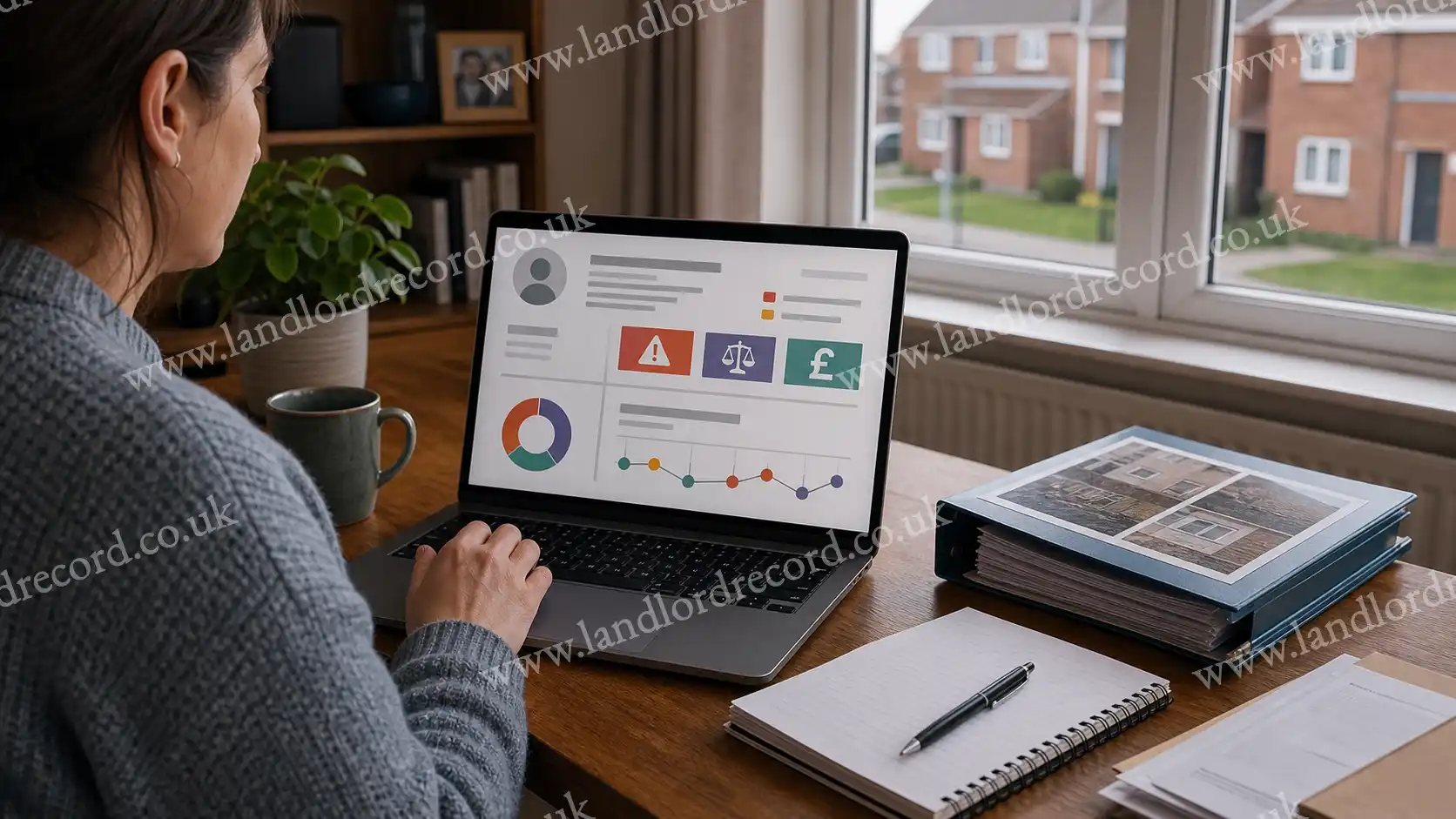
When you open a landlord profile — by searching on the landlords page or clicking a name in a ranking — you see a summary and a list of decisions. The summary typically includes:
| Metric | What it means |
|---|---|
| Decisions | Total published determinations for this landlord in our index. |
| Adverse findings | Outcomes where the Ombudsman found service failure, maladministration, partial maladministration or severe maladministration. |
| Maladministration rate | The percentage of decisions with an adverse finding. A higher rate means more upheld complaints relative to total cases. |
| Severe findings | The count of severe maladministration outcomes — the Ombudsman's most serious finding. |
| Compensation | Total compensation ordered across the landlord's indexed decisions. |
Each individual decision shows the case reference, decision date, complaint summary, outcomes for each complaint head, and any orders or compensation. You can read the full summary without leaving the site, and click through to the original decision on the Housing Ombudsman website. This is useful when you want to see the exact wording of a finding, the facts of a case that resembles your own, or the deadline the Ombudsman set for the landlord to comply.
The record therefore gives you three layers of information. First, the headline numbers — decisions, adverse findings and rate — which tell you how often the landlord appears in upheld determinations. Second, the outcome breakdown, which shows whether the landlord's record is mostly lower-level service failures or includes serious findings. Third, the individual decisions, which let you read the facts, the Ombudsman's reasoning and the specific orders made.
To illustrate what the data looks like in practice, the current worst-landlords-overall ranking shows London & Quadrant Housing Trust with 1,010 adverse findings, followed by Clarion Housing Association Limited with 782 , and Peabody Trust with 527. These are raw counts of upheld findings in published determinations — not a quality score, but a concentration of the Ombudsman's published caseload. Source: Landlord Record analysis of Housing Ombudsman decisions (OGL v3.0).
How to use the record before you complain
Checking your landlord's record before you submit or escalate a complaint is useful for three reasons.
First, it tells you what the Ombudsman has already found against your landlord. If the landlord has repeated findings in the same category — for example responsive repairs or damp and mould — that pattern is relevant evidence. It does not guarantee your complaint will be upheld, but it shows the landlord has been found at fault for similar issues before.
Second, it shows you what remedies the Ombudsman has ordered for similar cases. You can read past decisions to see whether the Ombudsman typically orders an apology, compensation, a specific repair, a policy review or staff training. This helps you frame your complaint in realistic terms and understand what "putting things right" might look like. For more on how compensation works, see our compensation guide.
Third, it gives you a benchmark. If your landlord has a high maladministration rate or a large number of severe findings, that context can be useful when you write to your landlord or escalate to the Ombudsman. It is not an argument on its own — the Ombudsman decides each case on its own facts — but it can help you understand whether your experience fits a broader pattern. You can also compare your landlord to others of a similar size or type, which helps you judge whether the record is unusually poor or roughly in line with peers.
How to use the record while complaining
Once your complaint is in progress, the landlord record remains a useful reference. You can cite specific past decisions when you write to your landlord or the Ombudsman, provided you do so accurately and fairly. The case reference, decision date and outcome are all verifiable on the original decision page.
You can also use the record to track whether your landlord is complying with orders. The Ombudsman monitors compliance, and past decisions show what the landlord was ordered to do and by when. If you suspect a landlord is repeating a failing that has already attracted an adverse finding, that is relevant context for your complaint and for any escalation.
The record is not, however, a substitute for the formal complaint process. You should still follow your landlord's complaints procedure, keep evidence, and escalate to the Ombudsman only after the landlord has had a reasonable opportunity to respond. The record helps you understand the landscape; it does not replace the steps required to get your own case investigated.
Where the data comes from and how it is licensed
Every decision on Landlord Record comes from the Housing Ombudsman Service's published decisions archive, released under the Open Government Licence v3.0. We do not collect complaints from residents or landlords directly. We download, structure, index and analyse the published determinations so they are searchable by landlord, issue, outcome and compensation.
The OGL allows reuse of public-sector information for any purpose, including commercial use, provided the source is acknowledged. Landlord Record acknowledges the Housing Ombudsman Service as the original source and publishes its analysis under the same licence terms. You are free to cite, share or link to any landlord record on this site.
Because the data is derived from published decisions, it has a natural time lag. A decision is only available after the Ombudsman publishes it, and there is typically a gap between the complaint date and the publication date. The index is updated as new decisions are released. For the methodology, see our data page.
We do not alter the Ombudsman's findings, add estimated fields, or mix in external data sources. If a figure is not returned by the existing query functions, it is left out. That means the record is reproducible from the site's own build-time data and traceable back to the original published determinations.
What the record cannot tell you
The record is powerful but narrow. It does not include complaints that were resolved by the landlord before reaching the Ombudsman, complaints outside the Ombudsman's jurisdiction, or complaints that are still in progress. It also does not include internal complaints that never escalated beyond the landlord's own process.
That means a landlord with few published decisions is not necessarily a better landlord than one with many. It may simply have fewer homes, better internal resolution, or fewer residents who escalate to the Ombudsman. The fairest reading is always comparative: look at the maladministration rate alongside the raw count, read the individual decisions, and treat the record as one source of evidence among several.
How to find a specific landlord
The simplest route is the landlords page, which lists every landlord in the index. You can search by name or browse alphabetically. If you are looking for housing associations specifically, the worst housing associations page and the which housing association has the most complaints guide both filter the dataset to housing associations.
For a ranked view across all landlords, use the worst landlords overall league table. This orders every landlord by adverse findings and lets you click through to any profile. You can also start from a specific issue — for example responsive repairs or health and safety — and find landlords with decisions in that category.
Sources
The primary source is the Housing Ombudsman decisions archive. The Ombudsman's Complaint Handling Code sets out the framework landlords must follow. For the official position on remedies and findings, see the Housing Ombudsman website.
Frequently asked questions
How do I check my landlord's complaints record?
Go to the Landlord Record landlords page, search for your landlord by name, and open its profile. The profile shows every published Housing Ombudsman decision for that landlord, including outcomes, complaint categories, compensation and orders. You can also browse the worst-landlords-overall ranking or the worst housing associations list to find a landlord's record.
Can I see how many complaints my housing association has?
Yes. Each landlord profile displays the total number of published decisions and the number of adverse findings (outcomes where the Ombudsman found service failure or maladministration). These are counts of published Ombudsman determinations, not every internal complaint the landlord receives. For housing associations specifically, see the guide to which housing association has the most complaints.
What is a landlord's maladministration rate?
The maladministration rate is the share of a landlord's published decisions where the Ombudsman found maladministration, partial maladministration or severe maladministration. It is expressed as a percentage. A higher rate means a larger proportion of the landlord's Ombudsman cases were upheld against it. This figure is shown on each landlord profile where the data is available.
Where does this landlord data come from?
All landlord data on Landlord Record comes from the Housing Ombudsman Service's published decisions, released under the Open Government Licence v3.0. We do not collect complaints directly from tenants or landlords. We structure, index and analyse the published determinations so they are searchable by landlord, issue, outcome and compensation.
Is my landlord's record official?
The underlying decisions are official Housing Ombudsman publications. Landlord Record is an independent analysis layer: we organise and present those published decisions, but we are not affiliated with or endorsed by the Housing Ombudsman Service. The record is an accurate reflection of the Ombudsman's published determinations for that landlord.
How do I compare two landlords?
Open each landlord's profile in a separate tab and compare the decision count, adverse findings, maladministration rate, severe maladministration count and total compensation. For a ranked view, use the worst-landlords-overall league table, which orders all landlords by adverse findings. Remember that larger landlords naturally have more decisions, so compare the maladministration rate and severe findings alongside raw counts.