Guide
Pests in Social Housing: Whose Responsibility Is It?
A plain-English guide to when your landlord must treat pests, what the law says, and how to take action if they refuse.
By the Landlord Record research team · Reviewed against Housing Ombudsman published guidance · Last updated 30 May 2026
Landlord Record is independent and is not affiliated with, or endorsed by, the Housing Ombudsman Service. We organise and analyse decisions published under the Open Government Licence.
Your landlord is responsible for dealing with pest infestations that are caused by problems with the building or communal areas. Under section 11 of the Landlord and Tenant Act 1985 , social landlords in England must keep the structure and exterior of your home in repair. The Homes (Fitness for Human Habitation) Act 2018 goes further: your home must be fit for human habitation, and a serious pest infestation can make it unfit.
Our analysis of Housing Ombudsman decisions shows that pest and infestation issues appear in 775 published determinations. — Landlord Record analysis of Housing Ombudsman decisions (OGL v3.0)
If your landlord fails to investigate or treat an infestation, you can escalate your complaint to the Housing Ombudsman — a free, independent service that can order the landlord to put things right. You can also ask your local council's environmental health team to inspect the property.
This guide explains when the landlord is responsible, when you might be, what to do if your landlord will not act, and how the Housing Ombudsman enforces compliance.
When is the landlord responsible for pests?
Landlord responsibility for pests depends on the cause of the infestation and the terms of your tenancy agreement. In almost all social housing tenancies, the landlord has legal duties that cover pest control in specific circumstances.
Structural defects and entry points
If pests are entering your home because of disrepair — holes in walls, broken air bricks, damaged drains, missing vent covers, or gaps around pipes — the landlord must fix the defect and arrange pest treatment. Section 11 of the Landlord and Tenant Act 1985 places a statutory duty on landlords to keep the structure and exterior in repair. This duty cannot be removed by your tenancy agreement.
Communal and shared areas
In blocks of flats or estates with shared spaces, the landlord is responsible for maintaining communal areas including bin stores, hallways, gardens, and drainage systems. If an infestation spreads because of poor waste management, blocked drains, or failure to maintain communal areas, the landlord must deal with the source and any affected homes.
Health and safety hazards
Under the Housing Health and Safety Rating System (HHSRS), local councils assess housing conditions for hazards that affect health. Pest infestations can be classed as category 1 hazards — the most serious — if they pose a significant risk to health. The Homes (Fitness for Human Habitation) Act 2018 also requires the property to be free from hazards. A severe infestation of rats, mice, or cockroaches can make a property unfit.
When the tenant is responsible
You may be responsible for pest control if the infestation is caused by your own actions or neglect. Examples include poor food hygiene, failing to dispose of rubbish properly, or hoarding that creates nesting conditions. In these cases, the landlord may still have a duty to repair structural entry points, but the cost of pest treatment may fall to you. Check your tenancy agreement for specific terms, but remember that section 11 obligations override any contract term that tries to pass structural repair responsibility to you.
Common infestations and who usually deals with them
Different pests raise different responsibility questions. The table below sets out the usual position for the most common infestations in social housing.
| Pest | Usual cause | Who is responsible? |
|---|---|---|
| Rats | Broken drains, gaps in structure, poor waste storage | Landlord — structural repair and treatment |
| Mice | Small gaps, failed air bricks, poor hygiene | Landlord if structural; tenant if caused by hygiene |
| Bed bugs | Travel, second-hand furniture, neighbouring infestations | Often shared; landlord usually treats communal spread |
| Cockroaches | Food waste, moisture, communal drainage issues | Landlord if communal cause; tenant if personal neglect |
| Fleas | Pets | Usually tenant, unless property was infested before move-in |
What to do if you have a pest infestation
If you discover pests in your home, act quickly to protect your health and strengthen your complaint. Follow these steps in order.
-
Report it to your landlord in writing
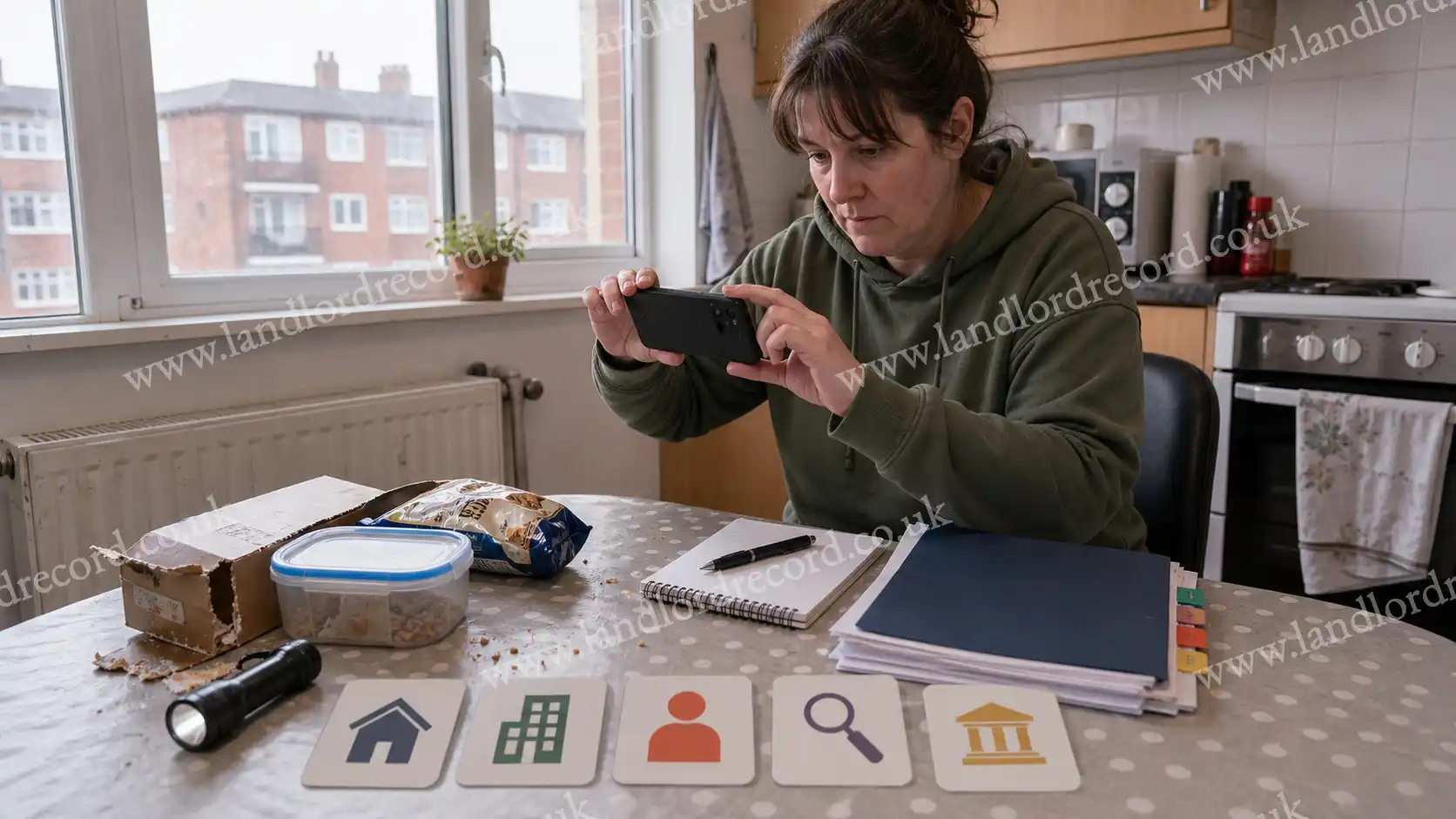
Email or letter is best — keep a copy. Describe the pest, where it is, when you first noticed it, and any health effects. Attach clear, dated photographs of the pests, droppings, damage, and any obvious entry points.
-
Allow a reasonable time for treatment
Urgent health risks such as rats should be dealt with in days. Less urgent issues may take slightly longer, but prolonged delays without explanation are unreasonable. Ask for a specific date for inspection and treatment.
-
Use your landlord's complaints process
If the landlord does not act, escalate through its formal complaints procedure. Ask for a final response so you can show you have exhausted the process. See our guide to what to do if your landlord won't fix repairs .
-
Contact the Housing Ombudsman
If you are unhappy with the final response, or the landlord does not respond, you can complain to the Housing Ombudsman for free. See our step-by-step guide to complaining .
-
Involve environmental health if needed
Your local council's environmental health team can inspect the property and use HHSRS powers to require the landlord to act. This is especially useful if the infestation is severe and poses an immediate health risk.
Enforcement: complaint, Ombudsman, and environmental health
If your landlord refuses to treat an infestation or delays unreasonably, you have three main enforcement routes.
The landlord's complaints process
Every social landlord must have a complaints procedure that complies with the Housing Ombudsman's Complaint Handling Code. You must normally exhaust this process before the Ombudsman will investigate. Put your complaint in writing, keep copies, and note the dates of every response. If the landlord misses its own deadlines, note this — it strengthens your case.
The Housing Ombudsman
The Housing Ombudsman Service is free and independent. It investigates how your landlord handled your complaint. If it finds maladministration — for example failing to arrange pest treatment, ignoring reports, or leaving you in uninhabitable conditions — it can make binding orders. These include completing repairs and treatment, paying compensation, apologising, reviewing policies, and training staff. Pest complaints usually fall under the responsive repairs and health and safety categories.
Environmental health
Your local council's environmental health officers can inspect your home under the Housing Health and Safety Rating System. If they find a category 1 hazard — a serious risk to health or safety — they can issue an improvement notice or emergency remedial action notice requiring the landlord to treat the infestation and repair entry points. This is a powerful tool that does not depend on the landlord's willingness to cooperate.
What the Housing Ombudsman has ordered in pest cases
The Housing Ombudsman publishes its determinations, and we analyse them to understand what landlords are getting wrong and what remedies are ordered. Pest and infestation complaints most often involve failures to act on reports, delays in treatment, and failure to repair entry points that allow pests to return.
In our index of published decisions, pest and infestation issues appear in 775 determinations. — Landlord Record analysis of Housing Ombudsman decisions (OGL v3.0)
Where the Ombudsman finds maladministration in pest cases, it commonly orders the landlord to arrange professional pest treatment within a specific deadline, repair structural defects that allow entry, compensate the resident for distress and inconvenience, and review its pest control policy to prevent recurrence. These orders are binding, and the Ombudsman monitors compliance.
Sources
- Landlord and Tenant Act 1985, section 11 — legislation.gov.uk
- Homes (Fitness for Human Habitation) Act 2018 — legislation.gov.uk
- Housing Health and Safety Rating System (England) Regulations 2005 — legislation.gov.uk
- Housing Ombudsman Service — housing-ombudsman.org.uk
- HHSRS operating guidance — gov.uk
Related guides
Our index currently holds 18,064 published determinations from 625 landlords, including 2,441 with a finding of severe maladministration. Search the decisions or browse the severe maladministration rankings .
Frequently asked questions
Frequently asked questions
Is my landlord responsible for pest control?
Your landlord is responsible for pest control when the infestation is caused by a structural defect, disrepair, or arises from communal or shared areas. Under section 11 of the Landlord and Tenant Act 1985, landlords must keep the structure and exterior in repair, which includes blocking entry points. The Homes (Fitness for Human Habitation) Act 2018 also requires the property to be free from hazards that affect health. If pests enter because of holes in walls, broken drains, or poor waste management in communal areas, the landlord must act. If the infestation is caused purely by your own actions — for example poor food hygiene or unreported clutter — you may be responsible.
Are rats in a council house the landlord's responsibility?
Yes, in most cases. Rats in a council or housing association property are usually the landlord's responsibility to deal with, especially if they are entering through structural defects, broken drains, or gaps in the building fabric. Rats pose serious health risks and can make a property unfit for human habitation under the Homes (Fitness for Human Habitation) Act 2018. Your landlord should arrange pest treatment promptly and seal entry points. If the rats are present because of conditions in communal areas — such as overflowing bins or poor waste storage — that is also the landlord's responsibility.
What do I do about an infestation my landlord won't treat?
Report the infestation to your landlord in writing, keep dated copies, and take photographs of the pests and any damage or entry points. Allow a reasonable time for the landlord to act — urgent health risks should be dealt with in days. If the landlord refuses or delays without good reason, escalate through its formal complaints process and ask for a final response. Once the process is exhausted, you can complain to the Housing Ombudsman for free. See our guides on what to do if your landlord won't fix repairs and how to complain to your housing association for step-by-step help.
Can I get compensation for a pest infestation?
Yes, if the Housing Ombudsman finds that your landlord failed to deal with the infestation properly and this caused you distress, inconvenience, or financial loss. The Ombudsman can order compensation as part of its remedies. The amount depends on the severity and duration of the failing and its impact on you. Compensation is not automatic — you must show that the landlord knew or should have known about the problem and failed to act within a reasonable time. Keep records of all reports, photos, and any costs you have incurred.
Can the council help with pests?
Yes. Your local council's environmental health team can inspect your home if your landlord will not deal with a pest infestation. They have powers under the Housing Health and Safety Rating System (HHSRS) to require the landlord to take action if the infestation is a category 1 hazard. The council can also deal with pests in its own properties and, in some areas, offers pest control services to private and social tenants for a fee or free of charge. Contact your local council's environmental health department for advice.
Is mice infestation a health hazard the landlord must fix?
Yes. Mice can spread disease, contaminate food, and aggravate respiratory conditions through droppings and urine. A persistent mice infestation can make a property unfit for human habitation under the Homes (Fitness for Human Habitation) Act 2018. If mice are entering because of gaps in the building structure, broken air bricks, or failed drainage, your landlord must carry out pest treatment and repair the entry points. If the landlord fails to act, you can escalate through its complaints process and then to the Housing Ombudsman.