Guide
How to complain about your housing association
A step-by-step guide for social housing residents in England: the Stage 1 and Stage 2 process, when to escalate, and what the Housing Ombudsman can do.
Landlord Record is independent and is not affiliated with, or endorsed by, the Housing Ombudsman Service. We organise and analyse decisions published under the Open Government Licence.
If you need to complain about your housing association, the path is straightforward: make a formal Stage 1 complaint to your landlord, escalate to Stage 2 if you are not satisfied, take your case to the Housing Ombudsman, and then work through the Ombudsman's determination and any orders it makes. Our index holds 18,064 published Housing Ombudsman decisions across 625 landlords — checking your housing association's record before you complain can help you understand how it handles disputes.
-
Complain to your housing association (Stage 1)
Put your complaint in writing, keep copies, and ask your housing association to log it as a formal Stage 1 complaint. The landlord must respond within ten working days unless it explains why it needs more time.
-
Escalate to Stage 2 if you are unhappy
If the Stage 1 response does not resolve the matter, you can ask for a Stage 2 review. The landlord then has twenty working days to issue a final response. This is the end of its internal process.
-
Take your complaint to the Housing Ombudsman
If you are still unhappy — or the landlord has not responded within a reasonable time — you can bring your complaint directly to the Housing Ombudsman. You no longer need a designated person.
-
What to expect from the Ombudsman
The Ombudsman checks jurisdiction, gathers evidence, and reaches a determination on each part of your complaint. If it finds maladministration it makes orders the landlord must comply with.
Step 1 in detail: making your Stage 1 complaint
Start by putting your complaint in writing. An email is fine, but keep a copy and ask for a read receipt. Tell your housing association clearly what went wrong, when it happened, and what you want it to do to put things right. Ask explicitly that the complaint be logged as a formal Stage 1 complaint under the landlord's complaints procedure. If you only raise the issue informally — for example, a quick phone call or hallway conversation — it may not be treated as a formal complaint, and the landlord's time limits may not apply.
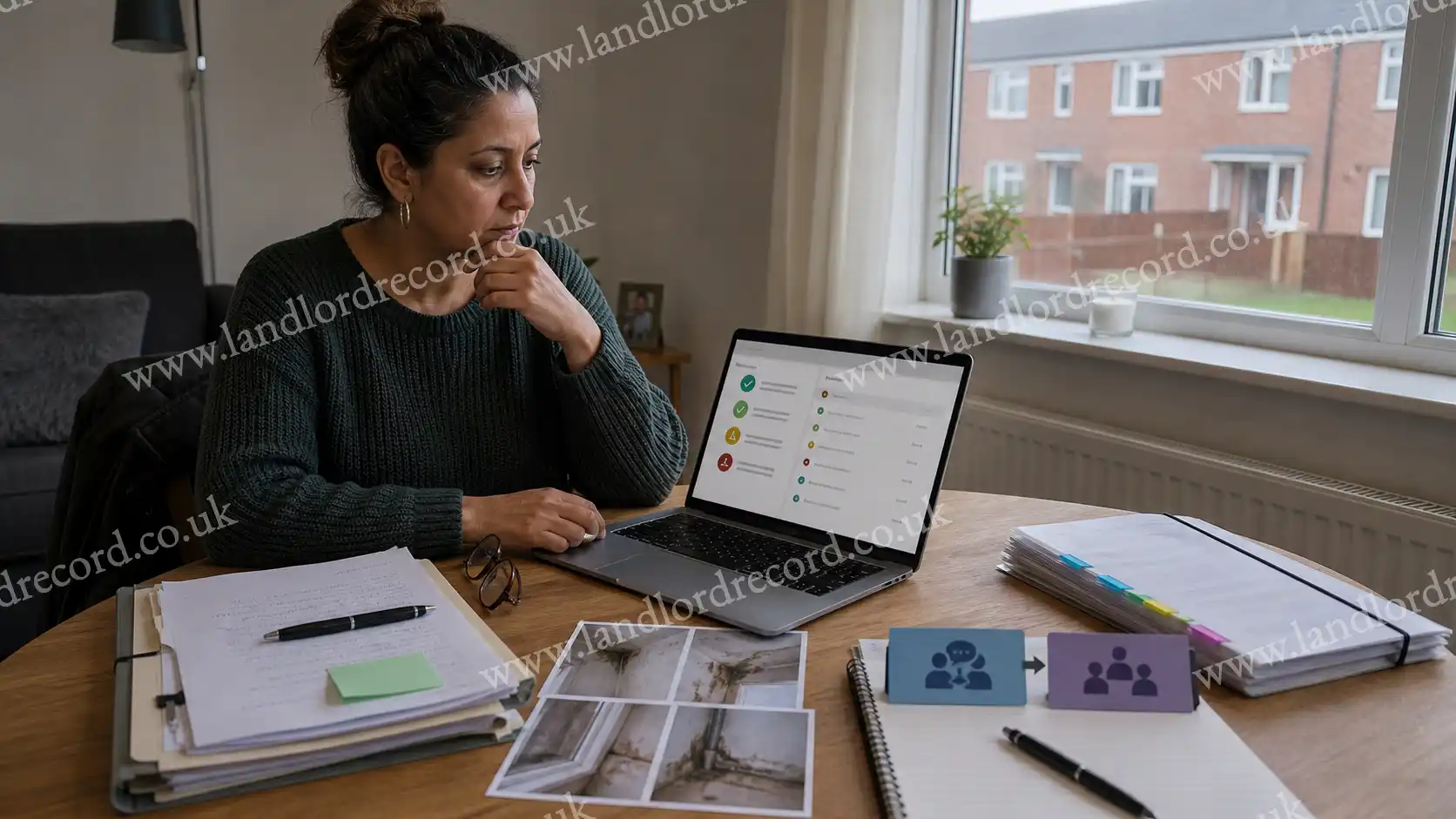
Be specific in your complaint. State the dates of events, the names of any staff you spoke to, and the impact the issue has had on you. If you are complaining about repairs, include photos and any previous repair requests with dates. If the issue involves your neighbours or anti-social behaviour, keep a dated log of incidents. The clearer your evidence, the harder it is for the landlord to dismiss your concerns.
Under the Housing Ombudsman's Complaint Handling Code, your landlord must acknowledge your complaint promptly and respond within ten working days. If it needs more time, it must explain why and give you a revised date. You do not have to use a special form — a clear, dated letter or email is enough. Keep records of every contact, including photos, repair requests, and any previous correspondence. If the landlord tries to resolve the issue at this stage and you are satisfied, the complaint can close. But if the response is inadequate, you retain the right to escalate.
Step 2 in detail: escalating to Stage 2
If the Stage 1 response does not resolve your complaint — or you think the landlord did not investigate properly — you can ask for a Stage 2 review. This is the final stage of the landlord's internal process. At Stage 2, the landlord must carry out a fresh, impartial review and issue a final response within twenty working days. Some landlords call this an "appeal" or a "review" — the name does not matter, but the process must meet the Ombudsman's standards.
When you escalate, explain clearly why the Stage 1 response was inadequate. Reference specific points the landlord missed or got wrong. Include any new evidence that has come to light since Stage 1. The Stage 2 response should address each of your concerns in full, explain the reasoning behind any decision, and set out what action the landlord will take. If the landlord upholds your complaint at Stage 2, make sure its proposed remedy is fair and complete before you accept it.
Once you receive the Stage 2 final response — or once the twenty-day deadline passes without a response — you have exhausted the landlord's process and can go to the Housing Ombudsman. Do not feel pressured to accept an inadequate Stage 2 response just because it is labelled "final." The Ombudsman exists precisely for situations where the landlord's own process has not put things right.
Step 3 in detail: taking your complaint to the Housing Ombudsman
The Housing Ombudsman is a free, independent service that resolves disputes between residents and social landlords. You can submit a complaint directly through the Ombudsman's website. You no longer need a "designated person" — such as an MP or local councillor — to refer your complaint. This changed in 2023, removing a barrier that previously delayed many residents from getting justice.
When you submit your complaint, include copies of your correspondence with the landlord, the Stage 1 and Stage 2 responses (if any), and a clear timeline of events. The Ombudsman will first check that your complaint is within its jurisdiction — for example, that the issue relates to your home or tenancy and is not already before a court. Matters that fall to another body — such as court proceedings already under way, or issues that belong to the police or local authority — may be outside the Ombudsman's scope.
After accepting your complaint, the Ombudsman gathers evidence from both sides. It may ask you and the landlord for additional documents or clarification. The process is inquisitorial, which means the Ombudsman investigates the facts rather than acting like a court with opposing sides. You do not need legal representation, though you are welcome to seek advice from organisations such as Citizens Advice or Shelter.
Step 4 in detail: what to expect from the Ombudsman
Once the Ombudsman has gathered enough evidence, it reaches a determination on each part of your complaint — each "complaint head." The possible outcomes range from no maladministration, meaning the landlord acted reasonably and in line with its obligations, through to maladministration, partial maladministration, or severe maladministration, which mean the landlord failed to meet its obligations in varying degrees of seriousness.
Where the Ombudsman finds against your landlord, it issues orders the landlord must comply with. These commonly include an apology, financial compensation, completing outstanding repairs or taking other specific action, reviewing a policy, changing a process, and staff training. The Ombudsman monitors whether the landlord complies with its orders and can publish follow-up reports if compliance is delayed. For more on how compensation is decided, see our compensation guide.
The Ombudsman's determination is not a court judgment, and you cannot appeal its final decision in the same way you would appeal a court ruling. However, the Ombudsman can re-open a case if new evidence emerges that was not available during the original investigation. Most determinations are published on the Ombudsman's website, which means the landlord's performance becomes part of the public record.
What good looks like: the Complaint Handling Code
The Housing Ombudsman's Complaint Handling Code sets the standards every member landlord must meet. A good complaints process is easy to access, acknowledges complaints promptly, keeps residents informed throughout, investigates fairly and thoroughly, and provides clear responses that explain the decision and any remedy offered. If your housing association falls short of these standards — for example, by failing to acknowledge your complaint, refusing to log it formally, or providing a generic response that does not address your concerns — that shortfall can itself form part of your complaint to the Ombudsman.
The Code also requires landlords to learn from complaints. This means your housing association should identify patterns, fix systemic problems, and tell you what it has changed as a result. If you see the same issue affecting multiple residents, or if your landlord repeatedly makes the same mistake, that can indicate a deeper problem that the Ombudsman will take seriously.
Understanding what the Ombudsman considers maladministration helps you frame your complaint around specific failings rather than general frustration. Unreasonable delays, poor communication, a refusal to follow policy, or a failure to keep accurate records are all common grounds for adverse findings. The more specific and evidence-based your complaint, the stronger your position — and the clearer it is for the Ombudsman to reach a fair determination.
Check your housing association's Ombudsman record before you complain
Before you start your complaint, it is worth checking how your landlord has performed in past Housing Ombudsman decisions. Our landlords page lets you search any registered provider and see its full decision history, including adverse findings, severe maladministration determinations, and any compensation ordered. You can also browse the worst housing associations league table to see which landlords have the most adverse findings in published determinations.
Looking at past decisions can help you understand whether your issue is part of a wider pattern. For example, if your complaint is about repairs, you can see whether the Ombudsman has previously found responsive repairs failures at your landlord. If your complaint is about damp and mould, you can check the worst damp and mould league table to see how your landlord compares. This does not guarantee any outcome in your individual case, but it can help you set realistic expectations and present your case more clearly.
Knowing your landlord's record also helps you decide whether to push for a particular remedy. If the Ombudsman has previously ordered your landlord to carry out staff training or review a policy for the same type of failing, you can reference that in your complaint. It shows the landlord has been told to fix this before and has not done enough to prevent the problem recurring.
If your housing association ignores your complaint
Sometimes landlords fail to respond at all. If your housing association does not acknowledge your Stage 1 complaint within a reasonable time, or misses the ten-day response deadline without explanation, you do not have to wait indefinitely. Document the lack of response — note the dates you sent your complaint and any follow-up messages — and escalate to Stage 2 or go directly to the Housing Ombudsman. A reasonable time is generally understood to be the ten working days set by the Complaint Handling Code, though the Ombudsman may allow a short extension if the landlord explains the delay properly.
The Ombudsman can accept complaints where the landlord has failed to respond within a reasonable time, even if you have not technically completed the landlord's process. The key is to show that you gave the landlord a fair chance to put things right and that it failed to engage. Keep everything in writing: emails, letters, text messages, and notes of phone calls. If you spoke to someone on the phone, follow up with an email summarising what was said. This creates a paper trail that the Ombudsman can follow.
If your complaint involves urgent issues such as serious disrepair or health and safety risks, you may also need to contact your local council's environmental health team while your complaint progresses. The council has powers to inspect the property and require the landlord to carry out works. Our housing disrepair compensation guide explains more about this route and how it interacts with the Ombudsman process.
Remember that going to the Ombudsman does not stop you from pursuing other remedies. If your landlord's failing has caused you significant loss or harm, you may want to seek independent legal advice alongside the Ombudsman route. The Ombudsman process is free and can run in parallel with other action, provided the same issue is not already before a court.
Our index currently holds 18,064 published determinations across 625 landlords. Every statistic is drawn from published Housing Ombudsman decisions — Landlord Record analysis of Housing Ombudsman decisions (OGL v3.0). Search the decisions or browse the worst-landlords-overall league table.
Frequently asked questions
Frequently asked questions
Which housing association has the most complaints?
Based on our analysis of published Housing Ombudsman decisions, London & Quadrant Housing Trust currently has the highest number of adverse findings. You can see the full picture in our worst-housing-associations league table and search any landlord's record on our landlords page.
What are the 5 steps of the complaint process?
From a resident's perspective, the complaint journey has five stages: 1) raise your complaint with the landlord and ask for it to be logged formally, 2) receive an acknowledgement, 3) the landlord investigates and issues a Stage 1 response, 4) if you remain unhappy you escalate to Stage 2 for a final review, and 5) if the matter is still unresolved you take it to the Housing Ombudsman.
What is a stage 2 complaint in housing?
Stage 2 is the final stage of a landlord's internal complaints process. If you are not satisfied with the Stage 1 response, you can ask for a Stage 2 review. The landlord must then carry out a fresh, impartial review and issue a final response. Once Stage 2 is complete — or if the landlord fails to respond within the set time — you can escalate to the Housing Ombudsman.
How do I escalate a complaint to the Housing Ombudsman?
You can submit a complaint to the Housing Ombudsman online through its website. The service is free, and you do not need a solicitor. Since 2023 you no longer need a designated person to refer your complaint. You will need to show that you have exhausted your landlord's complaints process, or that the landlord has not responded within a reasonable time.
How long does a housing association have to respond to a complaint?
Under the Housing Ombudsman's Complaint Handling Code, a landlord should respond to a Stage 1 complaint within ten working days. If it needs more time, it must explain why and give you a revised date. For a Stage 2 escalation, the landlord has twenty working days to issue its final response.
What can I do if my housing association ignores my complaint?
If your housing association does not acknowledge or respond to your complaint within a reasonable time, you can escalate directly to the Housing Ombudsman. Document every contact — dates, names, and what was said — so you can show the Ombudsman that the landlord failed to follow its process. You can also escalate to Stage 2 if you received a Stage 1 response but it was inadequate.
Sources
- Housing Ombudsman Service — Make a complaint
- Housing Ombudsman Service — Complaint Handling Code and guidance
- Legislation.gov.uk — for underlying housing and tenancy legislation
- GOV.UK — for social housing regulation and resident rights
This page is an information resource and does not constitute legal advice. If you need support with your complaint, free advice is available from Citizens Advice and Shelter.