Guide
The Decent Homes Standard: what your landlord must do
A plain-English guide to the four criteria every social home must meet, how the standard is enforced, and what you can do if your landlord fails to provide a decent home.
By the Landlord Record research team
Independent analysis of published Housing Ombudsman decisions. Last updated: 30 May 2026.
Reviewed against Housing Ombudsman published guidance.
This is general information, not legal advice.
Landlord Record is independent and is not affiliated with, or endorsed by, the Housing Ombudsman Service. We organise and analyse decisions published under the Open Government Licence.
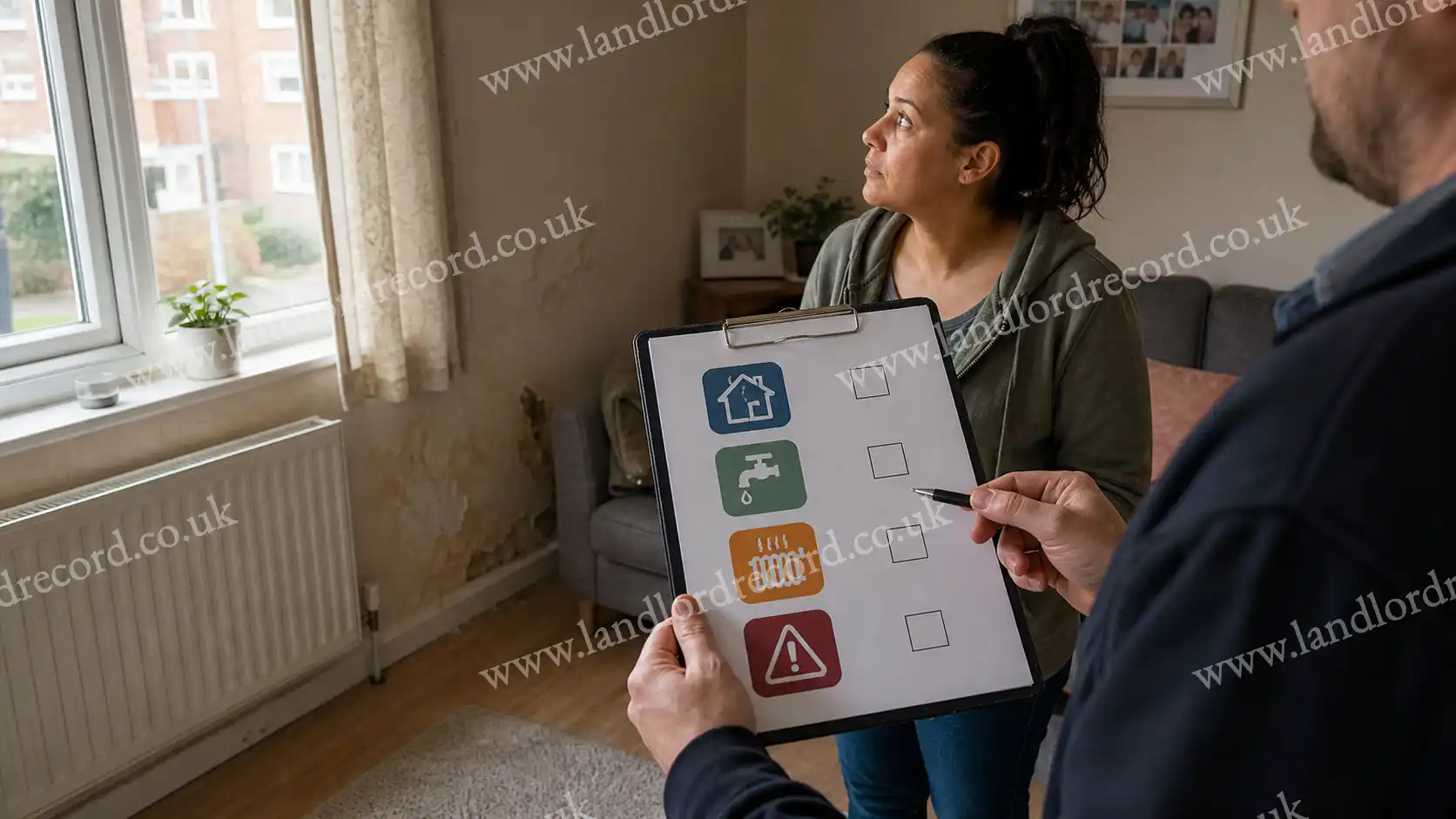
The Decent Homes Standard is the minimum standard that social housing in England must meet. Introduced in 2000, it requires every social home to satisfy four criteria: it must be free of serious hazards, in a reasonable state of repair, have reasonably modern facilities, and provide a reasonable degree of thermal comfort. If your landlord fails to meet any of these criteria, your home is not decent and you have routes to hold them accountable.
Our index holds 18,064 published Housing Ombudsman determinations, many of which involve failures that overlap with the Decent Homes Standard — from unresolved damp and mould to broken heating and delayed repairs. Landlord Record analysis of Housing Ombudsman decisions (Open Government Licence v3.0).
This guide explains what the four criteria mean in practice, how the standard is enforced, the planned extension to private landlords through the Renters' Rights Bill, and what you can do if your home falls short.
The four criteria for a decent home
The gov.uk guidance sets out four criteria. A home is decent only when it meets all four. Here is what each one means for you as a tenant.
1. It meets the current statutory minimum standard for housing
This criterion means your home must have no Category 1 hazards under the Housing Health and Safety Rating System (HHSRS). Category 1 hazards are the most serious risks to health and safety. They include severe damp and mould, excess cold, structural collapse, fire risks, and dangerous electrics. If a hazard is serious enough to cause harm, your landlord must act to remove or reduce it.
Local authorities have enforcement powers under the Housing Act 2004 to deal with Category 1 hazards, including serving improvement notices or carrying out emergency remedial action. In practice, many tenants raise these issues through their landlord first, then escalate to the Housing Ombudsman if the response is inadequate.
2. It is in a reasonable state of repair
Your home must be structurally stable and the key building elements must be in reasonable condition. This includes the roof, walls, windows, doors, and external finishes. It also covers key installations for water, gas, electricity, and sanitation. These must be working and safe.
A landlord cannot let a property fall into disrepair and claim it is still decent. Broken windows, leaking roofs, faulty wiring, or a collapsed bathroom floor would all breach this criterion. The standard is about the condition of the property as a whole, not just cosmetic issues.
3. It has reasonably modern facilities and services
This criterion covers the age and condition of the kitchen, bathroom, and other key facilities. A decent home should have a kitchen that is not too old to be usable and a bathroom that is in good working order. The standard also expects adequate space and layout, as well as proper ventilation and lighting.
The test is not whether the kitchen or bathroom is brand new. It is whether the facilities are old enough to be a problem — for example, a kitchen with no adequate food preparation space, or a bathroom with no working bath or shower. Landlords must maintain and replace these facilities when they reach the end of their useful life.
4. It provides a reasonable degree of thermal comfort
Your home must have effective insulation and heating so that it can be kept warm at a reasonable cost. This criterion is about both the fabric of the building — wall and loft insulation, double glazing where appropriate — and the heating system itself. A home with no insulation and an ancient, inefficient boiler is unlikely to meet this standard.
Excess cold is a Category 1 hazard under the HHSRS, so a home that is dangerously cold fails both the first and fourth criteria. If you cannot heat your home to a safe temperature without spending an unaffordable amount on energy, your landlord may need to improve insulation or replace the heating system.
How the standard is enforced
For social housing landlords, the Regulator of Social Housing monitors compliance with the Decent Homes Standard. Social landlords are expected to maintain their stock so that it meets the standard, and the Regulator can take enforcement action where landlords are systematically failing. This includes setting improvement targets and, in serious cases, regulatory intervention.
For individual tenants, the most direct route is through your landlord's complaints procedure. If the landlord does not put things right, you can escalate to the Housing Ombudsman. The Ombudsman investigates complaints about social landlords in England and can order remedies including repairs, compensation, an apology, and policy changes. See our guide to complaining to your housing association for the steps.
Local councils also have enforcement powers under the Housing Act 2004. If your home has a Category 1 hazard, the council can require the landlord to fix it. This applies to both social and private landlords.
The Renters' Rights Bill extension
The government has proposed extending the Decent Homes Standard to the private rented sector through the Renters' Rights Bill. If passed, private landlords in England would have to meet the same four criteria as social landlords. This would mean private tenants could expect their homes to be free of serious hazards, in reasonable repair, with modern facilities, and thermally comfortable.
The extension would bring private renting closer to the standards already expected of social housing. It would also give tenants clearer grounds to demand repairs and improvements, and would make it easier for local authorities to enforce against substandard properties. The exact timeline and enforcement mechanism will depend on the final legislation.
What to do if your home fails the standard
If you believe your home does not meet the Decent Homes Standard, follow these steps:
- Report the problem in writing. Email or write to your landlord with a clear description of the issue. Include photographs and keep a dated record of every report and response.
- Use the formal complaints procedure. If the landlord does not act, submit a formal complaint. Ask for a written response and reference the Decent Homes Standard or HHSRS hazards where relevant.
- Escalate to the Housing Ombudsman. If you are not satisfied with the landlord's final response, you can take your complaint to the Ombudsman for free. The Ombudsman can order compensation, repairs, an apology, and policy changes.
- Contact your local council. If there is a serious hazard, the council's environmental health team can inspect the property and take enforcement action against the landlord.
- Seek legal advice. In some cases, you may have a claim for breach of contract, disrepair, or under the Homes (Fitness for Human Habitation) Act 2018. A solicitor or advice agency can help you understand your options.
Evidence is critical. Keep photographs, medical notes if your health has been affected, a timeline of every report, and copies of all correspondence. The Ombudsman and the courts are both evidence-led, and a clear, dated timeline often matters more than the legal label you attach to the problem.
Disrepair data: where homes fall short of decent
Housing Ombudsman decisions give a clear picture of the gaps between the Decent Homes Standard and reality. Many complaints that reach the Ombudsman involve failures that map directly onto the four criteria: hazards, repair, facilities, and thermal comfort.
In our index of 18,064 published determinations, 6,165 are tagged with damp and mould. Damp and mould can be a Category 1 hazard, so these cases often represent a direct breach of the first Decent Homes criterion. Landlord Record analysis of Housing Ombudsman decisions (Open Government Licence v3.0).
9 decisions relate to broader repairs issues, covering everything from structural problems to broken fixtures. These cases show where landlords have failed to keep properties in a reasonable state of repair. Landlord Record analysis of Housing Ombudsman decisions (Open Government Licence v3.0).
3 decisions involve kitchen-related failures, and 4 involve bathroom-related failures. These touch on the modern facilities criterion, where outdated or broken facilities fall below the decent threshold. Landlord Record analysis of Housing Ombudsman decisions (Open Government Licence v3.0).
Across all categories, 2,441 decisions include a finding of severe maladministration — the most serious failing the Ombudsman can record. Many of these involve prolonged disrepair, ignored hazards, or repeated failures to act, all of which are incompatible with the Decent Homes Standard. Landlord Record analysis of Housing Ombudsman decisions (Open Government Licence v3.0).
These figures show that the gap between the standard and reality is measurable. If your landlord is not maintaining your home, you are not alone — and the Ombudsman's published decisions show that complaints can lead to enforceable orders for repairs and compensation. You can browse decisions in the responsive repairs category to see how the Ombudsman has framed orders in comparable cases. For more on damp and mould specifically, see our guide to landlord responsibility for damp and mould.
Frequently asked questions
What is the Decent Homes Standard?
The Decent Homes Standard is the minimum standard that social housing in England must meet. It was introduced in 2000 and requires every home to satisfy four criteria: it must be free of serious hazards, in a reasonable state of repair, have reasonably modern facilities, and provide a reasonable degree of thermal comfort. The standard is currently enforced for social landlords by the Regulator of Social Housing, and the government plans to extend it to the private rented sector through the Renters' Rights Bill.
What are the criteria for a decent home?
A decent home must meet four criteria. First, it must meet the current statutory minimum standard for housing — this means no Category 1 hazards under the Housing Health and Safety Rating System (HHSRS). Second, it must be in a reasonable state of repair, meaning the structure and exterior are sound and key installations are working. Third, it must have reasonably modern facilities and services, including a reasonably modern kitchen and bathroom. Fourth, it must provide a reasonable degree of thermal comfort, which means effective insulation and efficient heating.
Does the Decent Homes Standard apply to private landlords?
Currently, the Decent Homes Standard applies to social housing landlords in England — local authorities and registered providers such as housing associations. Private landlords are not yet formally covered by the Decent Homes Standard, although they must still meet basic legal obligations such as ensuring properties are fit for human habitation under the Homes (Fitness for Human Habitation) Act 2018. The Renters' Rights Bill proposes extending the Decent Homes Standard to the private rented sector, which would require private landlords to meet the same four criteria.
What can I do if my home isn't decent?
If your home does not meet the Decent Homes Standard, start by reporting the problems to your landlord in writing and keeping a dated record. If the landlord does not act, use their formal complaints procedure. If you are still dissatisfied after the final response, you can escalate your complaint to the Housing Ombudsman for free. The Ombudsman can order the landlord to carry out repairs, pay compensation, apologise, and change its policies. In some cases, you may also be able to take legal action or involve the Regulator of Social Housing.
Is damp a breach of the Decent Homes Standard?
Yes. Damp and mould can constitute a Category 1 hazard under the Housing Health and Safety Rating System (HHSRS), which means a home with serious damp or mould is unlikely to meet the Decent Homes Standard. A home must be free of serious hazards to be classed as decent. If your landlord has failed to investigate or repair damp and mould, you can complain through their formal process and escalate to the Housing Ombudsman if necessary.
How is the Decent Homes Standard enforced?
For social housing, the Regulator of Social Housing monitors compliance with the Decent Homes Standard and can take enforcement action where landlords are systematically failing. Social landlords must also meet the standard as part of their regulatory framework. For individual tenants, the main enforcement route is through the landlord's complaints process and, if unresolved, the Housing Ombudsman. The Ombudsman cannot directly fine a landlord for breaching the Decent Homes Standard, but it can order remedies including repairs and compensation for the failings. The government has also proposed that the Decent Homes Standard be enforced in the private rented sector through the Renters' Rights Bill.
Sources
The standards and duties described here are set out in official government guidance:
- Decent Homes Standard guidance (gov.uk)
- Renters' Rights Bill (gov.uk)
- Housing Act 2004 (legislation.gov.uk)
- Homes (Fitness for Human Habitation) Act 2018 (legislation.gov.uk)
For the Ombudsman's approach to complaints, remedies and determinations, see the Housing Ombudsman website.
This page summarises and explains that material; it is not produced by the Ombudsman and does not constitute legal advice.