Guide
Is My Landlord Responsible for Damp and Mould?
A plain-English guide to when your landlord must fix damp and mould, what the law says, and how to complain if they do not act.
By the Landlord Record research team · Reviewed against Housing Ombudsman published guidance · Last updated 30 May 2026
Landlord Record is independent and is not affiliated with, or endorsed by, the Housing Ombudsman Service. We organise and analyse decisions published under the Open Government Licence.
Yes — in most cases, your landlord is responsible for damp and mould that is caused by problems with the building itself. Under section 11 of the Landlord and Tenant Act 1985 , social landlords in England must keep the structure and exterior of your home in repair. The Homes (Fitness for Human Habitation) Act 2018 goes further: your home must be fit for human habitation, and severe damp or mould can make it unfit.
Our analysis of Housing Ombudsman decisions shows that damp and mould is one of the most common complaint themes, appearing in 6,165 published determinations. — Landlord Record analysis of Housing Ombudsman decisions (OGL v3.0)
If your landlord fails to investigate or repair damp and mould, you can escalate your complaint to the Housing Ombudsman — a free, independent service that can order the landlord to put things right.
Damp and mould are not just cosmetic issues. They can damage your belongings, make heating bills higher, and seriously affect your health. Understanding where the law places responsibility helps you argue your case with confidence and know when your landlord is falling short of its legal duties.
The law: three key pieces of legislation
Three laws set out your landlord's obligations. You do not need to quote them to your landlord, but knowing them helps you understand your rights.
Section 11, Landlord and Tenant Act 1985
This is the foundation of repairing obligations in England. It says your landlord must keep in repair:
- The structure and exterior of your home — including the roof, walls, gutters, drains, and external pipes.
- Installations for the supply of water, gas, electricity, and sanitation — including basins, sinks, baths, and toilets.
- Installations for space heating and heating water.
If damp or mould is caused by a structural problem — a leaking roof, cracked gutter, failed damp-proof course, or leaking pipe — this is almost always the landlord's responsibility to fix. The obligation applies regardless of whether your tenancy agreement mentions it explicitly, because section 11 is a statutory duty that cannot be overridden by a contract term.
Homes (Fitness for Human Habitation) Act 2018
This Act implies a covenant into most tenancy agreements that the property must be fit for human habitation at the start of the tenancy and throughout. "Unfit" includes problems with damp and mould that affect health or make the home unsafe or unsanitary. Unlike section 11, which focuses on repair, this Act focuses on the condition of the home. If severe damp or mould makes your home unfit, your landlord is in breach regardless of whether a specific repair is needed. The Act applies to most tenancies in England, including secure, assured, and introductory tenancies. If your landlord does not put things right, you can take court action for breach of covenant — though many tenants choose to complain to the Housing Ombudsman first because it is free and can order remedies quickly.
Awaab's Law
Awaab's Law is a new set of requirements for social landlords, named after Awaab Ishak, a two-year-old who died in 2020 from a respiratory condition caused by prolonged exposure to mould in his home. The law introduces strict time limits:
- Landlords must investigate reported damp and mould within 14 days.
- If the damp or mould is hazardous, repairs must begin within 7 days.
- Emergencies must be dealt with within 24 hours.
Awaab's Law is being brought into force in stages. Even where it is not yet fully in force, the Housing Ombudsman already expects landlords to act promptly on damp and mould. Failure to do so is a common ground for a finding of maladministration.
Condensation, penetrating damp, and rising damp — who is responsible?
Not all damp is the landlord's fault. The cause matters because it determines who should pay for the repair and any associated damage.
Condensation
Condensation is the most common cause of damp in homes. It happens when moisture in the air — from breathing, cooking, showering, and drying clothes — hits a cold surface and turns to water. Over time, this can lead to black mould on walls, ceilings, and around windows.
Condensation is sometimes caused by tenant lifestyle, but it is often made worse — or entirely caused — by the property itself. If your home lacks adequate ventilation, insulation, or heating, the surfaces stay cold and moisture builds up. In those cases, the landlord is responsible. Under the Homes (Fitness for Human Habitation) Act 2018, a home with persistent condensation mould caused by inadequate ventilation can be classed as unfit.
Common landlord failings that cause condensation include missing or broken extractor fans, single-glazed windows with no trickle vents, inadequate loft or wall insulation, and inefficient or unresponsive heating systems. If you are using the ventilation and heating provided and still have persistent mould, the cause is likely the property itself.
Penetrating damp
Penetrating damp is caused by water entering the building from outside — for example through a leaking roof, cracked gutter, broken pipe, or damaged wall. It usually appears as a growing patch on an internal wall or ceiling that corresponds to an external defect. This is a repair issue and falls squarely under section 11 of the Landlord and Tenant Act 1985. Your landlord must fix the source of the leak and repair any resulting damage.
Rising damp
Rising damp occurs when groundwater rises up through the walls because the damp-proof course (DPC) has failed or is missing. It typically affects ground-floor walls and may leave a "tide mark" of staining. A failed DPC is a structural repair issue and is the landlord's responsibility to put right.
| Type of damp | Usual cause | Who is responsible? |
|---|---|---|
| Condensation | Moisture hitting cold surfaces | Tenant (lifestyle) or landlord (ventilation/insulation defects) |
| Penetrating damp | Leaks from roof, gutters, pipes, cracks | Landlord — structural repair |
| Rising damp | Failed damp-proof course | Landlord — structural repair |
What to do if you have damp or mould
If you notice damp or mould in your home, follow these steps to protect your health and strengthen your complaint.
-
Report it to your landlord in writing
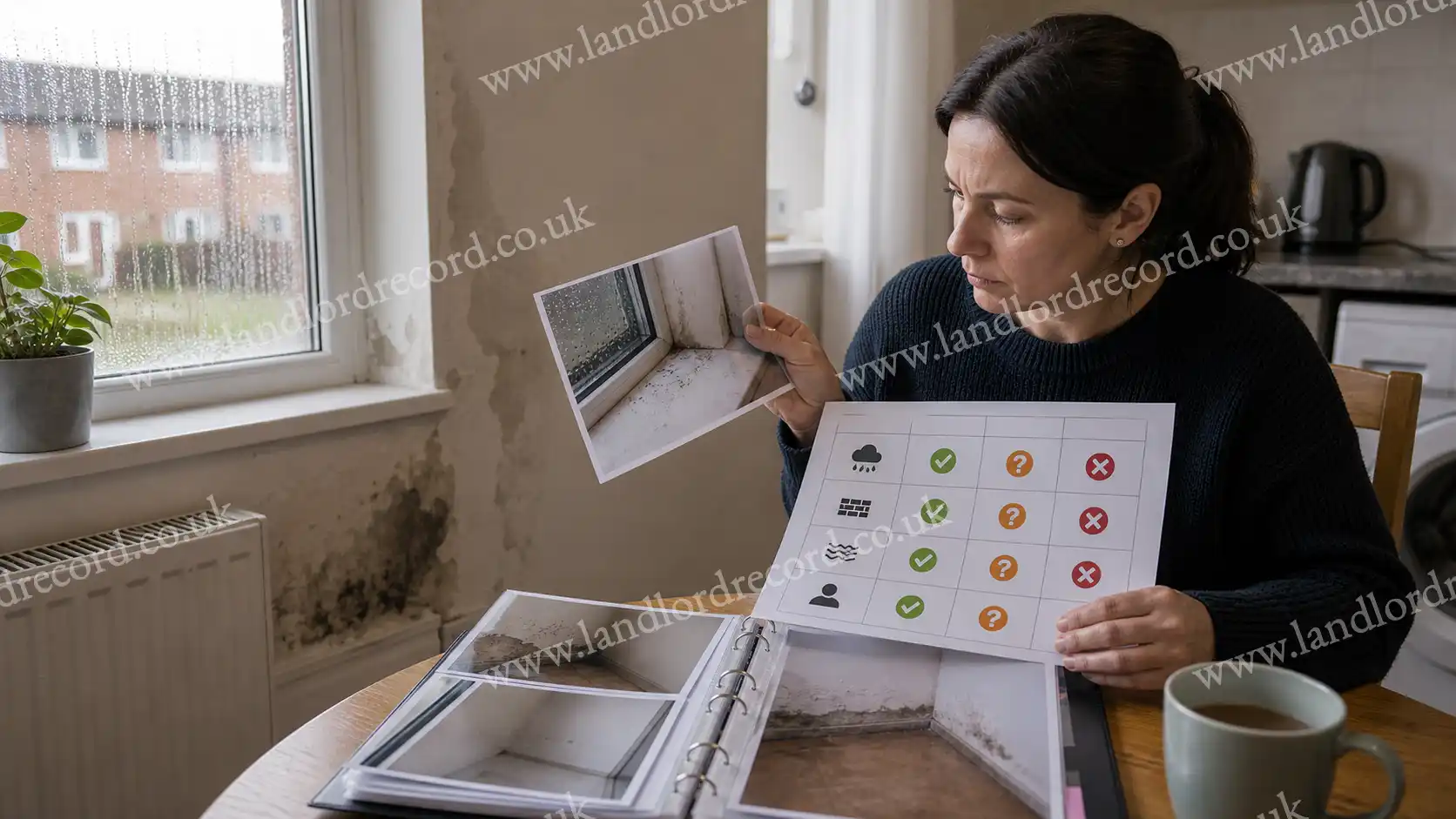
Email or letter is best — keep a copy. Describe the problem, where it is, when it started, and any health effects. Attach clear, dated photographs.
-
Allow a reasonable time for repair
Urgent health or safety risks should be dealt with in days, not weeks. Less urgent repairs may take longer, but prolonged delays without explanation are unreasonable.
-
Use your landlord's complaints process
If the landlord does not act, escalate through its formal complaints procedure. Ask for a final response so you can show you have exhausted the process.
-
Contact the Housing Ombudsman
If you are unhappy with the final response, or the landlord does not respond, you can complain to the Housing Ombudsman for free. See our step-by-step guide to complaining .
-
Document health effects and costs
If damp or mould has affected your health, keep a record of GP visits, prescriptions, and any time off work. Keep receipts for damaged belongings or extra heating costs. This evidence strengthens your complaint and supports any claim for compensation.
What the Housing Ombudsman has ordered in damp and mould cases
The Housing Ombudsman publishes its determinations, and we analyse them to understand what landlords are getting wrong and what remedies are ordered. Damp and mould complaints fall most often under the responsive repairs and health and safety categories.
In our index of published decisions, damp and mould appears in 6,165 determinations. — Landlord Record analysis of Housing Ombudsman decisions (OGL v3.0)
Where the Ombudsman orders compensation in damp and mould cases, the awards vary with the severity and duration of the failing. Based on our analysis of published decisions with compensation ordered:
| Measure | Value |
|---|---|
| Decisions with compensation ordered | 4,206 |
| Median award | £700 |
| Typical range (25th–75th percentile) | £350 – £1,300 |
| Average award | £1,195 |
| Highest single award | £358,282 |
— Landlord Record analysis of Housing Ombudsman decisions (OGL v3.0). These figures are indicative of past published cases only and do not predict any individual outcome.
Beyond compensation, the Ombudsman frequently orders landlords to complete a full survey of the property, install proper ventilation or insulation, and set clear deadlines for each stage of the work. It can also order the landlord to apologise, review its policies, and train staff so the same failing does not happen to other residents. These orders are binding, and the Ombudsman monitors compliance.
You can see which landlords have the most adverse findings for damp and mould in our worst damp and mould rankings.
Our index currently holds 18,064 published determinations from 625 landlords, including 2,441 with a finding of severe maladministration. Search the decisions or browse the worst damp and mould rankings .
Sources
- Landlord and Tenant Act 1985, section 11 — legislation.gov.uk
- Homes (Fitness for Human Habitation) Act 2018 — legislation.gov.uk
- Awaab's Law: a new law to protect tenants from damp and mould — gov.uk
- Housing Ombudsman Service — housing-ombudsman.org.uk
Related guides
Frequently asked questions
Frequently asked questions
Is it illegal to rent a property with damp?
There is no specific criminal offence of renting out a damp property. However, under the Homes (Fitness for Human Habitation) Act 2018, a property must be fit for human habitation, and severe damp or mould can make it unfit. Under section 11 of the Landlord and Tenant Act 1985, landlords are responsible for keeping the structure and exterior in repair. If a landlord fails to meet these obligations and the property becomes unfit, the tenant has legal remedies, including complaining to the Housing Ombudsman if the landlord is a member.
How quickly do landlords have to fix damp?
Landlords must carry out repairs within a reasonable time, which depends on the severity and risk. Urgent issues affecting health or safety should be addressed much faster. Under Awaab's Law, social landlords will be required to investigate reported damp and mould within 14 days and, where hazardous, begin repairs within 7 days. Until Awaab's Law is fully in force, landlords should still act promptly. If they do not, the Housing Ombudsman can find maladministration and order specific deadlines.
Is it the landlord's responsibility to get rid of mould?
Yes, if the mould is caused by a structural defect, disrepair, or inadequate ventilation or insulation that the landlord is responsible for. Under section 11 of the Landlord and Tenant Act 1985, the landlord must keep the structure and exterior in repair, which includes fixing leaks, rising damp, and failed damp-proof courses. The Homes (Fitness for Human Habitation) Act 2018 also requires the property to be free from hazards that affect health. If mould is caused purely by tenant lifestyle, for example drying large amounts of laundry indoors without any ventilation, the tenant may bear some responsibility.
Can a damp house cause health problems?
Yes. Damp and mould can aggravate respiratory conditions such as asthma, cause allergic reactions, and contribute to other health issues, particularly in children, older people, and those with weakened immune systems. The NHS and the Housing Ombudsman both recognise that prolonged exposure to damp and mould can be a serious health risk. This is why Awaab's Law was introduced, to prevent tragedies like the death of Awaab Ishak, a two-year-old whose death was linked to prolonged exposure to mould in his home.
What can I do if my landlord won't fix damp?
First, report the problem to your landlord in writing and keep copies, dated photos, and any responses. If the landlord does not act within a reasonable time, escalate through its formal complaints process. Once the landlord has issued its final response, or if it fails to respond, you can take your complaint to the Housing Ombudsman. The Ombudsman can investigate for free, and if it finds maladministration it can order the landlord to carry out repairs, pay compensation, apologise, and change its policies. See our guide to how to complain to your housing association for the full steps.
Is condensation the tenant's fault?
Not always. Condensation happens when moist air hits a cold surface and turns to water. Everyday activities create moisture, and some condensation is normal. However, if condensation is excessive because the property lacks adequate ventilation, insulation, or heating, the landlord may be responsible. Under the Homes (Fitness for Human Habitation) Act 2018, inadequate ventilation that leads to persistent mould can make a property unfit. If the landlord has provided proper ventilation and heating and the tenant does not use them, the tenant may be partly responsible.