Guide
Free Housing Complaint Letter Template (2026)
A ready-to-use complaint letter template for social housing residents in England. Copy, paste, and adapt it for your Stage 1 or Stage 2 complaint.
Reviewed against Housing Ombudsman published guidance.
Landlord Record is independent and is not affiliated with, or endorsed by, the Housing Ombudsman Service. We organise and analyse decisions published under the Open Government Licence.
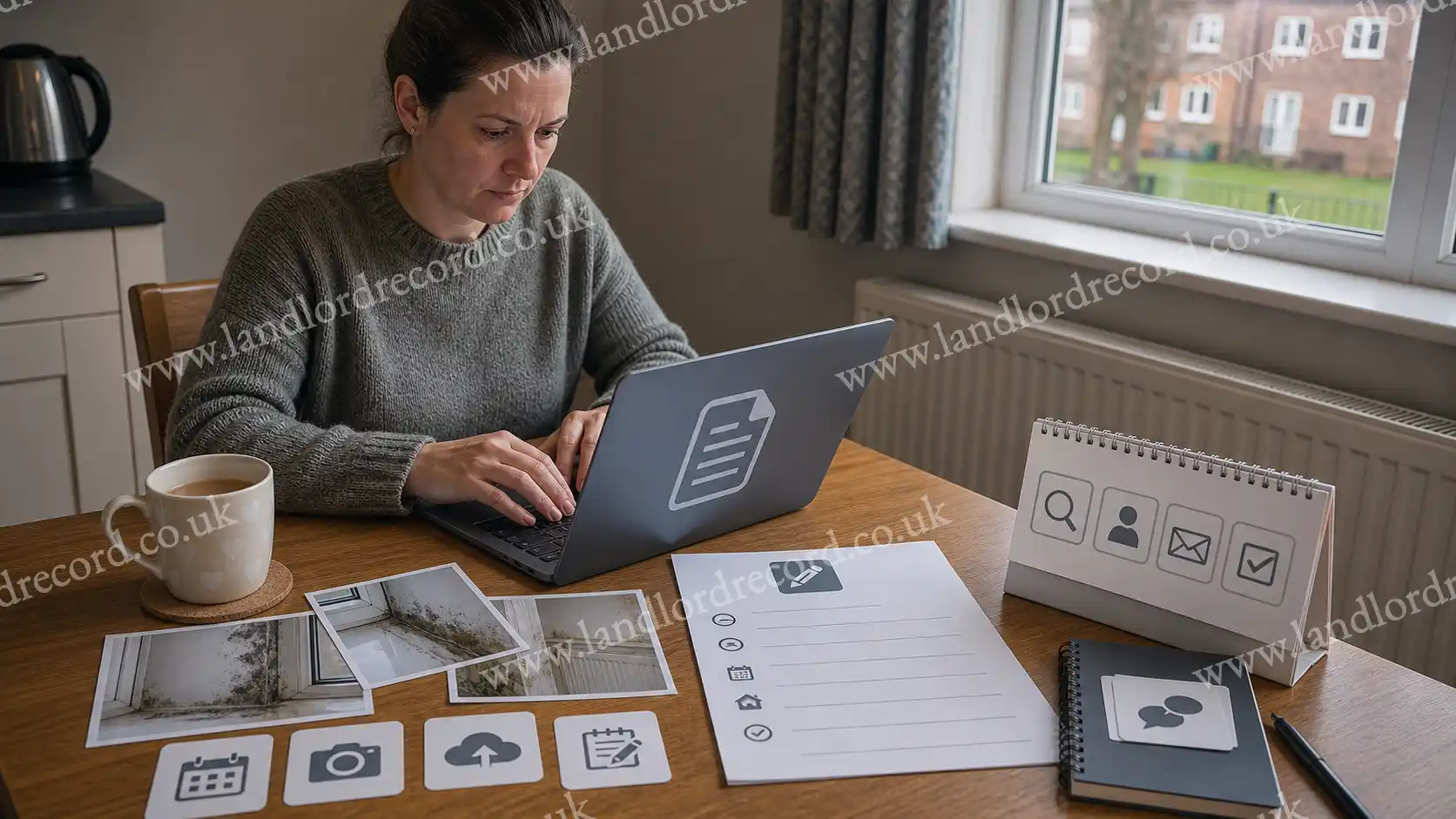
If you need to complain to your landlord, a clear, dated letter gives you the best chance of a fair response. It creates a paper trail, sets out your evidence, and shows the landlord — and later the Housing Ombudsman — exactly what went wrong and what you want done about it. Our index holds 18,064 published Housing Ombudsman decisions, and many of the strongest cases began with a well-documented written complaint.
What to include in your complaint letter
Before you copy the template, make sure you have gathered the details the letter needs. A strong complaint letter is specific, evidence-based, and polite. It should contain:
- Your details — full name, address, tenancy reference, phone number, and email.
- The date — so you can prove when you sent it.
- A clear statement — say explicitly that this is a formal Stage 1 complaint under the landlord's complaints procedure.
- What went wrong — describe the issue in chronological order, with specific dates and events.
- Evidence — mention photos, repair requests, emails, medical letters, or incident logs you have attached or can provide.
- The impact — explain how the issue has affected you or your household (for example, health, safety, inconvenience, or financial loss).
- The remedy you want — be clear about what you expect the landlord to do (for example, carry out repairs, apologise, pay compensation, or review a policy).
- A response deadline — request a written response within ten working days, in line with the Complaint Handling Code.
The template
Copy the text below into your word processor or email. Replace the bracketed placeholders with your own details. Keep the tone factual and avoid emotional language — the Ombudsman assesses evidence, not opinion.
Copy-paste template
[Your full name]
[Your address]
[Your tenancy / lease reference]
[Your phone number and email]

[Date]

[Landlord name]
[Landlord address / complaints team]

Dear [Landlord / Complaints Team],

Formal Stage 1 complaint — [short description of the issue]

I am writing to make a formal Stage 1 complaint about [describe the issue in one sentence].

Background

[Set out the timeline. For example:]
On [date], I first reported [the issue] to [name / team] by [email / phone / online form].
On [date], I followed up because [explain what happened, e.g. no response, partial repair, worsening condition].
[Continue the timeline with specific dates and what the landlord did or did not do.]

The issue has caused [describe the impact — e.g. health problems, inconvenience, financial loss, safety concern]. I have attached [list evidence: photos, repair requests, medical letters, correspondence].

What I want you to do

I would like you to [set out the remedy — e.g. complete the outstanding repairs within 14 days, apologise in writing, reimburse me £[amount] for [cost], carry out a full survey, review your policy].

Please respond to this complaint in writing within ten working days, in line with the Housing Ombudsman Complaint Handling Code. If you need more time, please explain why and give me a revised date.

If your response does not resolve this matter, I will escalate to Stage 2 and, if necessary, to the Housing Ombudsman.

Yours sincerely,

[Your signature — if posting]
[Your printed name]
How to use the template at each stage
Stage 1: the first formal complaint
Use the template exactly as written for your Stage 1 complaint. Send it to your landlord's complaints team — not just your housing officer — and ask for it to be logged formally. Under the Complaint Handling Code, the landlord must acknowledge your complaint promptly and respond within ten working days. If it needs more time, it must explain why.
Keep a copy of everything. If you email, save the sent message and request a read receipt. If you post, use recorded delivery and keep the tracking reference. A formal complaint triggers the landlord's internal process and sets the clock running for any later escalation to the Ombudsman.
Stage 2: the final internal review
If the Stage 1 response does not resolve your complaint, you can ask for a Stage 2 review. Use the template again, but change the opening line to "Formal Stage 2 complaint — request for review of Stage 1 response." Explain clearly why the Stage 1 response was inadequate, reference any new evidence, and ask for a final response within twenty working days.
Stage 2 is the final stage of the landlord's internal process. Once you receive the final response — or once the deadline passes without one — you have exhausted the landlord's process and can escalate to the Housing Ombudsman. For more detail, see our guide to complaining about your housing association.
Taking it to the Housing Ombudsman
If you are still unhappy after Stage 2, or the landlord has not responded within a reasonable time, you can bring your complaint to the Housing Ombudsman directly. You no longer need a designated person or Member of Parliament to refer you. Submit your complaint online through the Ombudsman's website.
Attach copies of your complaint letters, the landlord's responses (or evidence of no response), and any supporting documents. The Ombudsman will check jurisdiction, gather evidence, and reach a determination. See our guide to complaining to the Housing Ombudsman for the full process.
Worked example: damp and mould complaint
Below is a filled-in example based on a common complaint type. Adapt the facts to your own situation.
Worked example
Jane Smith
12 Oak Court
London NW1 1AA
Tenancy ref: 12345678
[email protected] / 07123 456789

30 May 2026

Acme Housing Association
Complaints Team
45 High Street
London EC1A 1BB

Dear Complaints Team,

Formal Stage 1 complaint — damp and mould in my home

I am writing to make a formal Stage 1 complaint about the ongoing damp and mould in my bathroom and bedroom, which Acme Housing Association has failed to resolve despite repeated reports.

Background

On 15 January 2026, I first reported damp and mould in the bathroom to the repairs team by email. I attached photographs showing black mould on the ceiling and walls.
On 28 January 2026, a contractor visited and applied a surface treatment. The mould returned within two weeks.
On 18 February 2026, I reported the recurrence by phone. I was told a surveyor would attend. No surveyor visited and I received no further communication.
On 10 March 2026, I emailed again. A different contractor attended on 25 March and repeated the same surface treatment. The mould has since spread to the bedroom.
On 5 May 2026, I visited my GP because my asthma had worsened. The GP letter notes that the damp environment is likely contributing to my respiratory symptoms.

The issue has caused significant distress, inconvenience, and health problems. I have attached: photos dated 15 January, 28 February, and 20 May; copies of my emails; and my GP letter dated 5 May 2026.

What I want you to do

1. Carry out a full structural survey of the bathroom and bedroom to identify the source of the damp within 14 days.
2. Complete all necessary repairs to stop the damp and remove the mould safely.
3. Provide a written apology for the delay and poor communication.
4. Pay me fair compensation for the distress, inconvenience, and impact on my health.

Please respond to this complaint in writing within ten working days, in line with the Housing Ombudsman Complaint Handling Code. If you need more time, please explain why and give me a revised date.

If your response does not resolve this matter, I will escalate to Stage 2 and, if necessary, to the Housing Ombudsman.

Yours sincerely,

Jane Smith
Tips that strengthen your complaint
- Be specific about dates. "I reported this on 15 January and again on 18 February" is stronger than "I have reported this several times."
- Attach evidence. Photos, repair request numbers, emails, and medical letters all add weight. Name your files clearly (for example, "bathroom-mould-15jan.jpg").
- State the remedy you want. The landlord and the Ombudsman need to know what "putting things right" looks like to you. Be reasonable but clear.
- Keep a timeline. A simple table of dates, contacts, and outcomes makes it easy for the Ombudsman to follow your case later.
- Stay factual. Avoid emotional language or personal accusations. The Ombudsman assesses whether the landlord met its obligations, not whether it was pleasant to deal with.
- Follow up in writing. If you speak to someone on the phone, send a brief email confirming what was said. This creates a paper trail.
- Know your landlord's record. Checking how your landlord has performed in past Ombudsman decisions can help you frame your complaint. See our landlords page to search any registered provider.
Our index currently holds 18,064 published determinations across 625 landlords. Every statistic is drawn from published Housing Ombudsman decisions — Landlord Record analysis of Housing Ombudsman decisions (OGL v3.0). Search the decisions or browse the league tables.
Frequently asked questions
Frequently asked questions
How do I write a complaint letter to my housing association?
Start with your name, address, and contact details. State clearly that you are making a formal Stage 1 complaint. Describe what went wrong, when it happened, and how it has affected you. Reference any previous reports or correspondence. Say what you want the landlord to do to put things right. Keep the tone factual and polite, and keep a copy of everything you send.
What should a housing complaint letter include?
A strong complaint letter includes: your contact details and tenancy reference; a clear statement that this is a formal complaint; a chronological description of the issue with dates; evidence such as photos or repair requests; the impact on you or your household; the remedy you want; and a request for a written response within the Complaint Handling Code timeframe.
How do I escalate to stage 2?
If you are not satisfied with the Stage 1 response, write to your landlord again and ask for a Stage 2 review. Explain why the Stage 1 response was inadequate, reference any new evidence, and request a final response within twenty working days. Once Stage 2 is complete — or if the landlord misses the deadline — you can escalate to the Housing Ombudsman.
Should I send my complaint by email or letter?
Either is acceptable. Email is faster and creates an automatic record, but a signed letter sent by recorded delivery can carry more weight if you later need to prove the landlord received it. If you email, request a read receipt. If you post, keep a copy and the tracking reference. Whichever method you use, keep dated copies of everything.
How long should I give the landlord to respond?
Under the Housing Ombudsman Complaint Handling Code, a landlord should acknowledge a Stage 1 complaint promptly and respond within ten working days. For a Stage 2 review, the landlord has twenty working days to issue a final response. If the landlord needs more time, it must explain why and give you a revised date. If it does not respond within these timeframes, you can escalate to the Housing Ombudsman.
What if I get no response?
If your landlord does not acknowledge or respond to your complaint within a reasonable time, document every attempt you made to contact them. You can then escalate directly to the Housing Ombudsman — you do not need to wait indefinitely. The Ombudsman can accept complaints where the landlord has failed to respond within a reasonable time, even if you have not completed the full internal process.
Sources
- Housing Ombudsman Service — Make a complaint
- Housing Ombudsman Service — Complaint Handling Code
- Legislation.gov.uk — for underlying housing and tenancy legislation
- GOV.UK — for social housing regulation and resident rights
This page is an information resource and does not constitute legal advice. If you need support with your complaint, free advice is available from Citizens Advice and Shelter.