Guide
Black Mould in a Rented Home: Rights & Health Risks
Black mould can harm your health and damage your belongings. Here is what the NHS says about the risks, when your landlord must act, and how the Housing Ombudsman puts things right.
By the Landlord Record research team
Independent analysis of published Housing Ombudsman decisions. Reviewed against Housing Ombudsman published guidance. Last updated: 30 May 2026.
Landlord Record is independent and is not affiliated with, or endorsed by, the Housing Ombudsman Service. We organise and analyse decisions published under the Open Government Licence.
Black mould in a rented home is a serious health risk, and in most cases your landlord is responsible for fixing the underlying cause. The NHS warns that mould can cause allergic reactions, asthma attacks and respiratory irritation , particularly in children, older people and anyone with a weakened immune system. When black mould appears because of structural defects, leaks, rising damp or inadequate ventilation, your landlord has a legal duty to act.
Our analysis of published Housing Ombudsman decisions shows that damp and mould is one of the most common complaint themes, appearing in 6,165 determinations. — Landlord Record analysis of Housing Ombudsman decisions (Open Government Licence v3.0).
If your landlord fails to investigate or repair the cause of black mould, you can escalate your complaint to the Housing Ombudsman — a free, independent service that can order the landlord to carry out repairs, pay compensation and change its policies.
Why black mould happens: damp vs condensation
Black mould is a type of fungus that grows on damp surfaces. It thrives where moisture is consistently present, so the key to stopping it is understanding the source of damp. There are three main causes, and who is responsible depends on which one applies to your home.
Condensation
Condensation is the most common cause of black mould in rented homes. It forms when warm, moist air hits a cold surface — walls, windows or ceilings — and turns into water. Everyday activities like breathing, cooking, showering and drying clothes all create moisture. Some condensation is normal, but persistent condensation that leads to black mould is often a sign that the property itself is the problem.
If your home lacks adequate ventilation, insulation or heating, surfaces stay cold and moisture builds up. Missing or broken extractor fans, single-glazed windows without trickle vents, and uninsulated walls are common landlord failings that cause condensation mould. Under the Homes (Fitness for Human Habitation) Act 2018 , a home with persistent condensation mould caused by inadequate ventilation can be classed as unfit for human habitation. If you are using the heating and ventilation provided and mould still grows, the cause is almost certainly the property, not your lifestyle.
Penetrating damp
Penetrating damp occurs when water enters the building from outside — through a leaking roof, cracked gutter, broken pipe, or damaged wall. It usually appears as a growing patch on an internal wall or ceiling that corresponds to an external defect. This is a structural repair issue and falls squarely under section 11 of the Landlord and Tenant Act 1985 . Your landlord must fix the source of the leak and repair any resulting damage, including black mould.
Rising damp
Rising damp happens when groundwater rises up through the walls because the damp-proof course (DPC) has failed or is missing. It typically affects ground-floor walls and may leave a "tide mark" of staining. A failed DPC is a structural repair issue and is the landlord's responsibility to put right under section 11 of the 1985 Act.
| Cause | What to look for | Who is usually responsible? |
|---|---|---|
| Condensation | Black mould around windows, on cold walls, behind furniture | Landlord if ventilation, insulation or heating is inadequate; tenant may share responsibility if ventilation is provided but not used |
| Penetrating damp | Growing patch on wall or ceiling after rain; stain below gutter or pipe | Landlord — structural repair under section 11 |
| Rising damp | "Tide mark" on ground-floor walls; crumbling plaster near skirting boards | Landlord — failed damp-proof course is a structural repair |
Your rights: the law on damp and mould
Three key pieces of legislation protect tenants from black mould in England. You do not need to quote them to your landlord, but understanding them helps you argue your case with confidence.
Section 11, Landlord and Tenant Act 1985
This Act imposes a statutory repairing obligation on social landlords. It requires them to keep in repair the structure and exterior of the home, including the roof, walls, gutters, drains and external pipes. It also covers installations for water, gas, electricity, sanitation, space heating and hot water. If black mould is caused by a structural defect — a leaking roof, cracked gutter, failed damp-proof course or leaking pipe — the landlord must fix it. This duty cannot be overridden by a tenancy agreement term.
Homes (Fitness for Human Habitation) Act 2018
This Act implies a covenant into most tenancy agreements that the property must be fit for human habitation at the start of the tenancy and throughout. "Unfit" includes problems with damp and mould that affect health or make the home unsafe or unsanitary. Unlike section 11, which focuses on repair, this Act focuses on the condition of the home. If severe black mould makes your home unfit, your landlord is in breach regardless of whether a specific repair is needed. The Act applies to most tenancies in England, including secure, assured and introductory tenancies.
Awaab's Law
Named after Awaab Ishak, a two-year-old who died in 2020 from a respiratory condition caused by prolonged exposure to mould in his home, Awaab's Law introduces strict time limits for social landlords:
- Investigate reported damp and mould within 14 days
- Begin repairs within 7 days where the condition is hazardous
- Deal with emergencies within 24 hours
Awaab's Law is being brought into force in stages. Even where it is not yet fully in force, the Housing Ombudsman already expects landlords to act promptly on damp and mould. Failure to do so is a common ground for a finding of maladministration. See our guide to Awaab's Law explained for more detail.
What to do if you have black mould
If you discover black mould in your rented home, act quickly to protect your health and build a strong complaint.
-
Report it in writing immediately
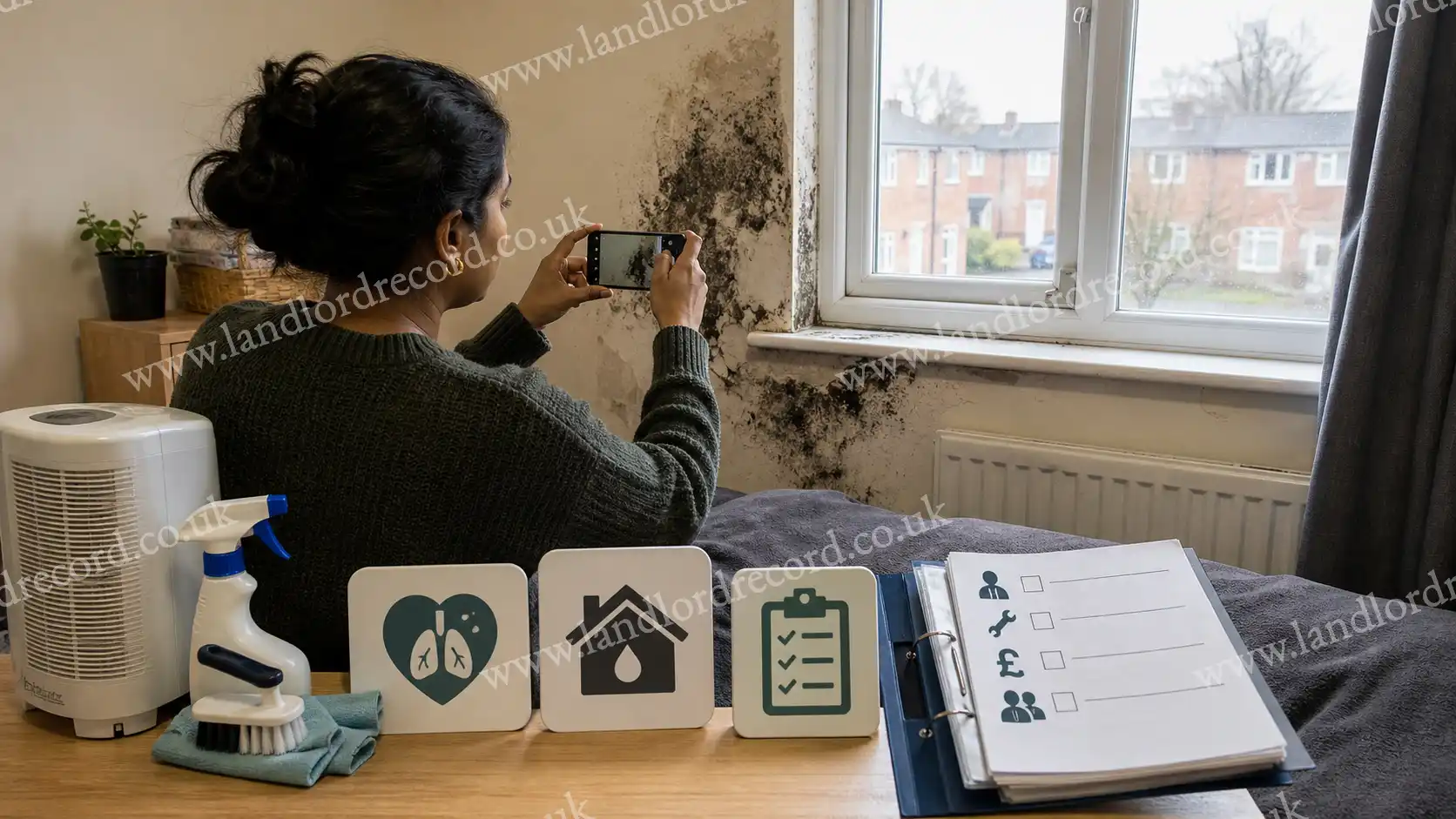
Email or letter is best — keep a copy. Describe the location, when it started, any musty smell, and any health effects. Attach clear, dated photographs of the mould and any surrounding damp or damage.
-
Identify the likely cause
Check whether the mould is near a window, behind furniture, on a ceiling below a roof or gutter, or on a ground-floor wall. The cause determines who is responsible and what repair is needed.
-
Allow a reasonable time for repair
Urgent health risks should be dealt with in days, not weeks. Black mould affecting a child's bedroom or a room used by someone with asthma should be treated as urgent.
-
Escalate through your landlord's complaints process
If the landlord does not act, use its formal complaints procedure and ask for a final response. You need to exhaust this process before going to the Housing Ombudsman.
-
Contact the Housing Ombudsman
If you are unhappy with the final response, or the landlord does not respond, you can complain to the Housing Ombudsman for free. It can order repairs, compensation, apologies and policy changes.
-
Document health effects and costs
Keep records of GP visits, prescriptions, time off work, and any extra heating or cleaning costs. Photograph damaged belongings. This evidence strengthens your complaint and supports any claim for compensation.
What the Housing Ombudsman has ordered in damp and mould cases
Black mould complaints fall most often under the responsive repairs and health and safety categories. The Ombudsman can order landlords to complete a full survey, install proper ventilation or insulation, set clear deadlines for works, apologise, review policies, train staff and pay compensation. These orders are binding and the Ombudsman monitors compliance.
Where the Ombudsman orders compensation in damp and mould cases, the figures reflect the severity, duration and impact of the failing. Based on our analysis of published decisions with compensation ordered:
| Measure | Value |
|---|---|
| Decisions with compensation ordered | 4,206 |
| Median award | £700 |
| Typical range (25th–75th percentile) | £350 – £1,300 |
| Average award | £1,195 |
| Highest single award | £358,282 |
— Landlord Record analysis of Housing Ombudsman decisions (Open Government Licence v3.0). These figures are indicative of past published cases only and do not predict any individual outcome.
You can see which landlords have the most adverse findings for damp and mould in our worst damp and mould rankings. For a full guide to compensation amounts, see our damp and mould compensation guide.
Sources
- NHS: Damp and mould — health risks and prevention
- Landlord and Tenant Act 1985, section 11 — legislation.gov.uk
- Homes (Fitness for Human Habitation) Act 2018 — legislation.gov.uk
- Awaab's Law: a new law to protect tenants from damp and mould — gov.uk
- Housing Ombudsman Service — housing-ombudsman.org.uk
Related guides
Our index currently holds 18,064 published determinations from 625 landlords, including 2,441 with a finding of severe maladministration. Search the decisions or browse the worst damp and mould rankings .
Frequently asked questions
Frequently asked questions
Is black mould dangerous?
According to the NHS, black mould can produce allergens, irritants and sometimes toxic substances. Inhaling or touching mould spores may cause an allergic reaction, such as sneezing, a runny nose, red eyes and skin rash. It can also trigger asthma attacks and irritate the lungs, eyes and skin. People with weakened immune systems, existing respiratory conditions, babies and older people are especially vulnerable.
Can a damp house cause health problems?
Yes. The NHS states that damp and mould in the home can cause or worsen respiratory problems, allergies and asthma. Prolonged exposure can lead to more serious health issues, particularly in children, older people and those with existing health conditions. The death of Awaab Ishak, a two-year-old who died from a respiratory condition linked to prolonged mould exposure in his home, led directly to Awaab's Law, which introduces strict time limits for social landlords to investigate and repair damp and mould.
Is my landlord responsible for black mould?
In most cases, yes. Under section 11 of the Landlord and Tenant Act 1985, social landlords must keep the structure and exterior of your home in repair, including fixing leaks, rising damp and failed damp-proof courses. The Homes (Fitness for Human Habitation) Act 2018 also requires the property to be free from hazards that affect health. If black mould is caused by structural defects, disrepair, inadequate ventilation or insulation the landlord is responsible for, they must put it right. If the mould is caused purely by tenant lifestyle, for example drying large amounts of laundry indoors without ventilation, responsibility may be shared.
How do I get rid of mould in a rented home?
Do not just clean the surface and ignore the cause. First, report the problem to your landlord in writing with dated photographs. Keep copies of all correspondence. If the mould is caused by a leak, rising damp or inadequate ventilation, the landlord must fix the underlying defect. You can wipe small patches with a fungicidal wash, but mould usually returns if the damp source is not resolved. If your landlord does not act within a reasonable time, escalate through their formal complaints process. Once you have a final response, or if they fail to respond, you can complain to the Housing Ombudsman for free.
Can I get compensation for black mould?
Yes, if the Housing Ombudsman finds that your landlord failed to meet its obligations and that this failure adversely affected you. In our analysis of published decisions, the median compensation award for damp and mould is £700 across 4,206 decisions with compensation ordered, with a middle range of £350 to £1,300. The actual amount depends on severity, duration, evidence and impact on your health and living conditions.
What is the new law on damp and mould?
Awaab's Law is a new set of requirements for social landlords in England, introduced after the death of Awaab Ishak. It requires landlords to investigate reported damp and mould within 14 days, begin repairs within 7 days where the condition is hazardous, and deal with emergencies within 24 hours. The law is being brought into force in stages. Even where not yet fully in force, the Housing Ombudsman already expects landlords to act promptly on damp and mould, and failure to do so is a common ground for maladministration.